Animals live almost everywhere — from freezing poles to burning deserts. How do they cope? Let's explore.
🎯 Learning goal: locate where different animals live, name the continent and climate, and explain how animals are adapted to their home.
1 · Match the animal to its continent
Tap an animal, then the continent it lives on in the wild.
Animal
Continent
2 · Built for their home
Tap a card to see how each animal is adapted to survive.
3 · Which adaptation helps?
💡 For grown-ups: covers KS2 geography (seven continents, climate zones) and science (adaptation). Extend by locating each animal on a world map and comparing the UK's climate with a desert or polar region.
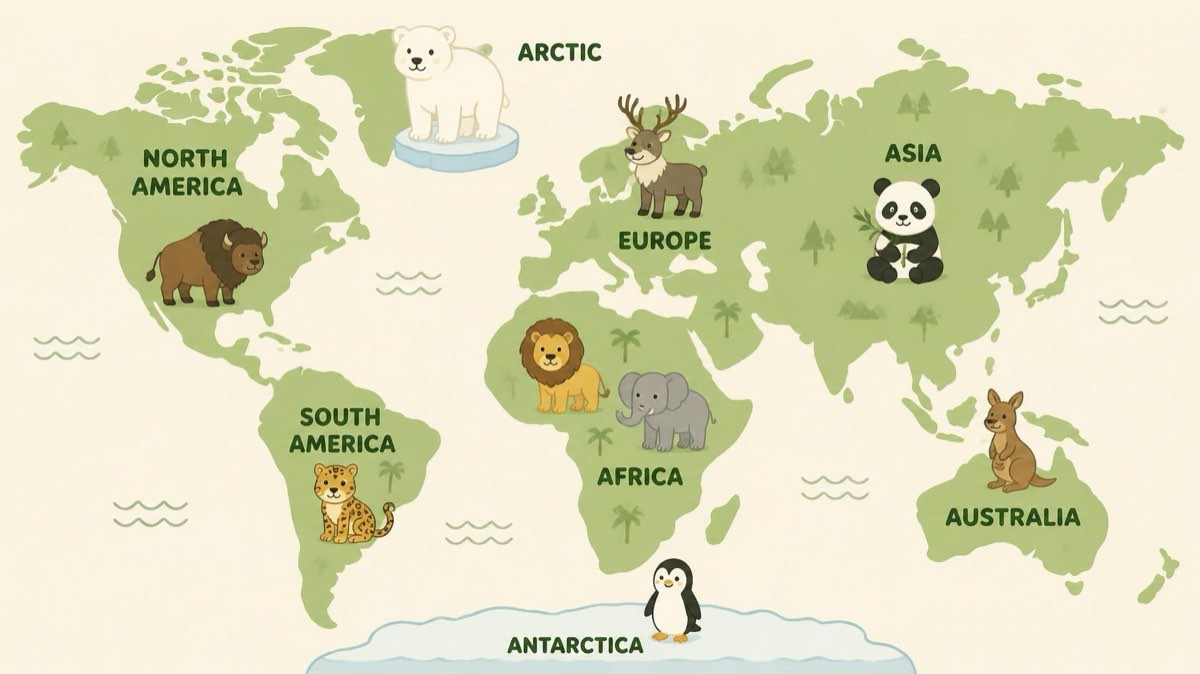
Where in the world?
Seven continents, and an animal that belongs to each. Print it and put it on the wall.
Watch out for the classic mix-up: polar bears live in the Arctic (the north), penguins in the Antarctic (the south). They are at opposite ends of the Earth and have never once met in the wild.
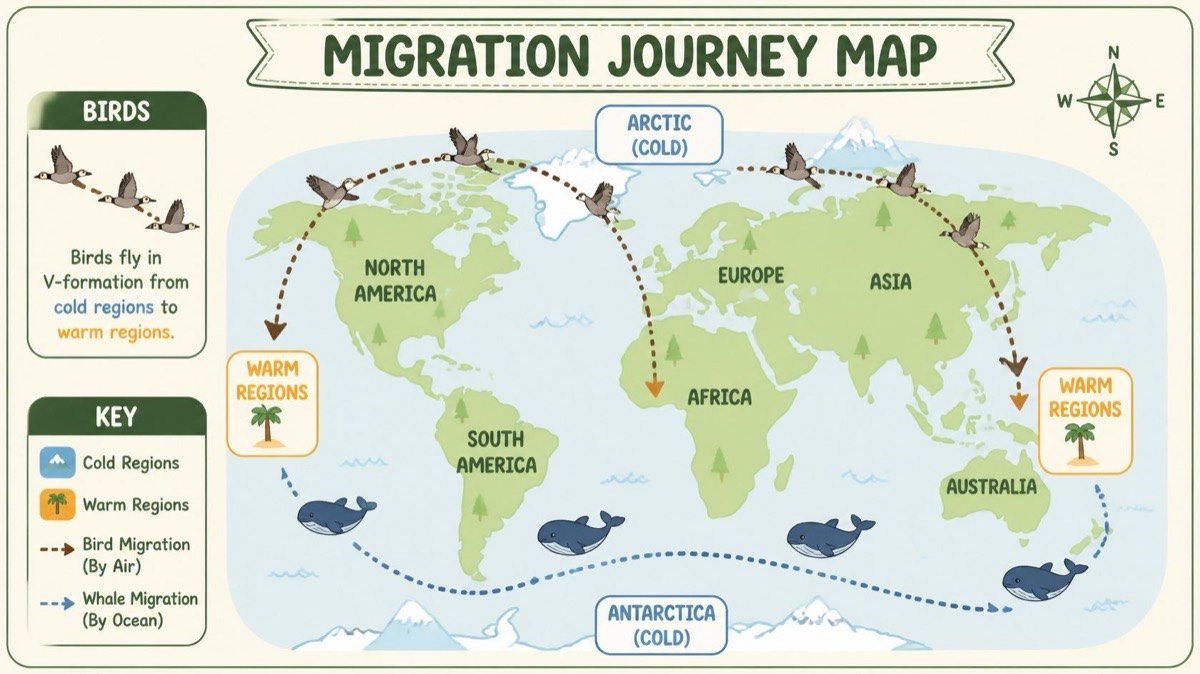
Migration — the longest journeys on Earth
Migration means travelling a long way and back again, every year, to follow the food and the
warmth.
The record holder is the Arctic tern. It flies from the Arctic to the Antarctic and back —
around 40,000 miles every year. Over its lifetime it flies roughly the distance to the Moon
and back three times.
And nobody teaches them the way. A young cuckoo raised in Britain by foster parents will fly to
Africa on its own, having never met its real mother and never been shown the route. The map is
somehow already inside it. We still do not fully understand how.
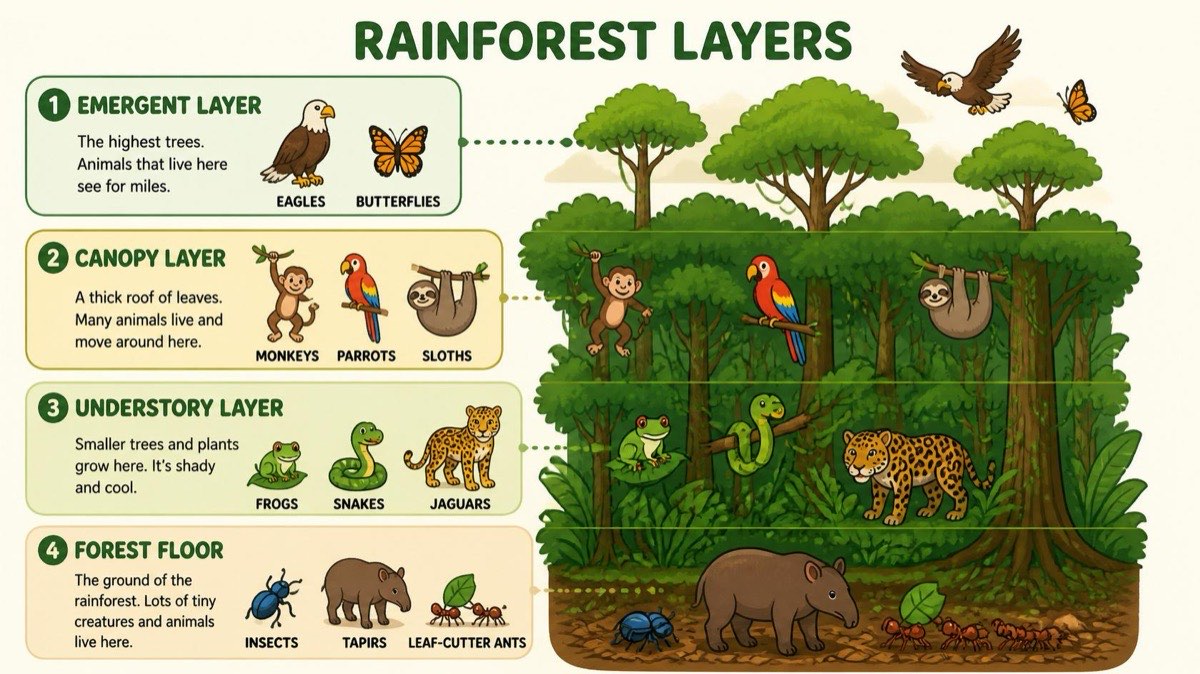
Rainforest layers
A rainforest is not one habitat — it is four, stacked on top of each other, and an animal
from one layer may never once visit another in its whole life.
Emergent (the tallest trees, in the sun) · Canopy (the leafy roof, where most of
the life is) · Understory (shady and still) · Forest floor (dark, and
surprisingly bare).
Here is the fact that surprises everyone: the forest floor is dark. Only about 2% of the
sunlight ever reaches it, because the canopy takes the rest. That is why the floor is not a jungle of
plants — it is mostly bare earth and fallen leaves. The jungle you are picturing is up in
the air.