Sarcasm, hinting, a compliment with a sting in it, an apology that is not one. These are the situations that are hardest to read when the words and the meaning do not match — and the ones most often explained too late, in the middle of an argument.
Each card shows one moment. The words in the picture are written out underneath it, so they can be read aloud, read by a screen reader, or searched for.
How to use these. One card at a time, away from the moment it relates to. Ask what the person might have meant, then what else they might have meant — the second answer matters more than the first. There is no correct answer on the card, and that is deliberate.
Do not use a card to make a point about something that happened today. These work when nobody is in trouble.
The cards
Tap any card to open it full size. Each one has the questions to ask folded underneath it.
Showing all 48 cards.
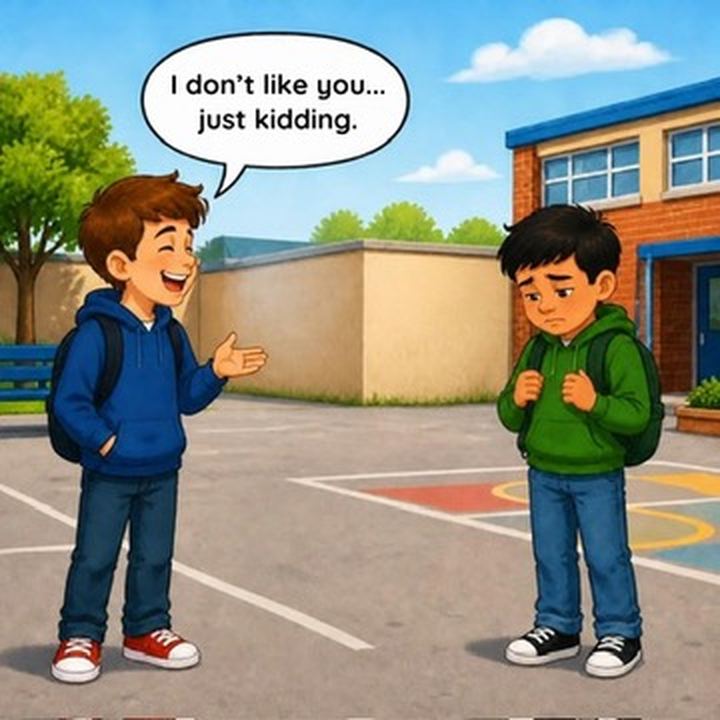
“I don’t like you… just kidding.”
How to use this card
“Just kidding” doesn’t delete what came before it.
What’s happening
The playground, before school. The boy in blue has delivered the line with a grin and an open hand, as though the joke were obvious. The boy in green has gone quiet and taken hold of his rucksack straps.
Each side of it
The boy in blue He meant nothing by it. The “just kidding” was attached from the start, so as far as he is concerned nothing was actually said.
The boy in green He heard the first four words at full strength. The ending arrived afterwards, and it doesn’t reach backwards.
What to ask
- What did the boy in green hear before the ending arrived?
- Did the boy in blue mean to hurt him? Does that settle it?
- What is “just kidding” for? What job is it doing at the end of a sentence?
- He can see the face now. What could he say?
- Has anyone said something to you that was “only a joke”? What did you do with it?
Things you could say
- “That came out wrong. I didn’t mean it — sorry.”
- “I know you were joking. It still didn’t feel good.”
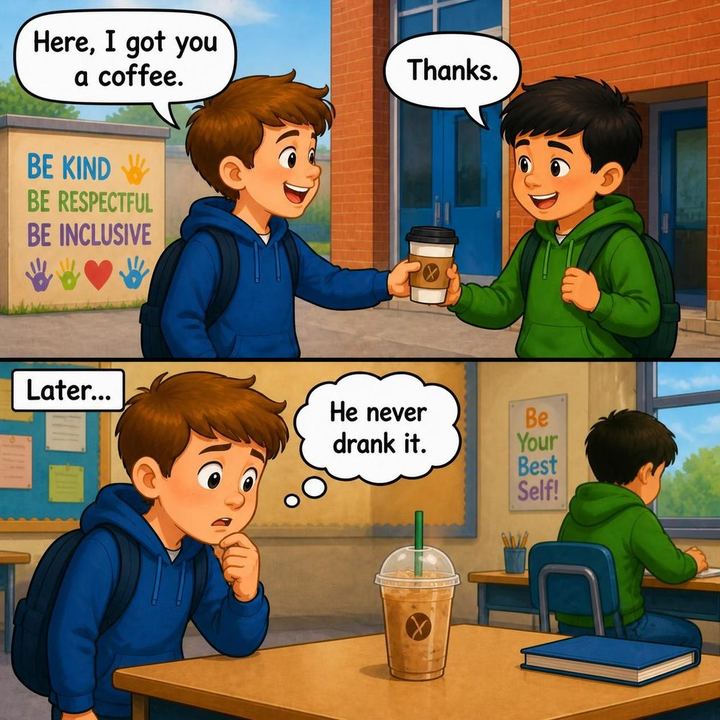
“He never drank it.”
How to use this card
A full cup can’t explain itself.
What’s happening
Two panels. In the first he buys his friend a coffee outside school and gets a thank you for it. In the second, later that day, the cup is sitting untouched on the desk and he is watching it while his friend gets on with his work.
Each side of it
Him The full cup feels like a message about him. He has spent the afternoon reading it.
His friend He took the coffee because it was a kind thing to be handed, and hasn’t thought about it since. He may not even drink coffee.
What to ask
- What has actually happened? Say only the parts you can see.
- What story has he told himself about it?
- How many other reasons could there be for a full cup? Count them out loud.
- How could he find out which one is true?
- Have you ever decided what somebody meant without asking them?
Things you could say
- “Did you not fancy it? I won’t get one next time.”
- “Sorry — I don’t drink coffee, I just didn’t want to say no.”
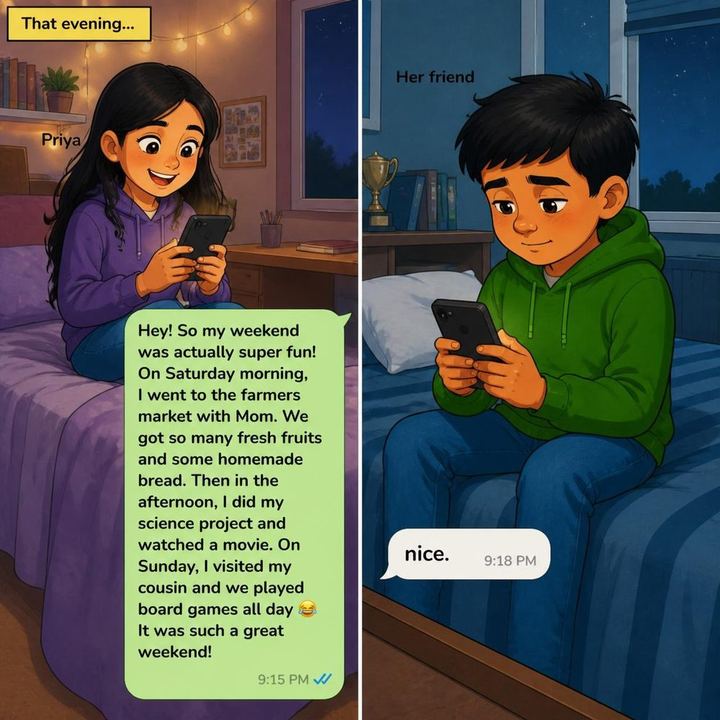
“nice.”
How to use this card
A short reply tells you about the person typing, not about you.
What’s happening
Priya sends a long, happy message about her weekend at 9:15. Three minutes later a one-word reply comes back: “nice.” Her friend is on his bed, comfortable, not annoyed in the slightest.
Each side of it
Priya She is about to reread her own message and decide it was too much.
Her friend He is tired and typing with one thumb. “nice.” is the whole of his answer, not a verdict on the message.
What to ask
- How long did she spend writing hers? How long did he spend on his?
- Look at his face in the picture. Does he look fed up?
- What are three reasons somebody sends a one-word reply?
- If she really needed to know, what could she ask?
- Do you send long messages or short ones? Does that say anything about how much you like someone?
Things you could say
- “Was that too long? Ha.”
- “Sorry, one-word mood tonight — sounds like a great weekend though.”
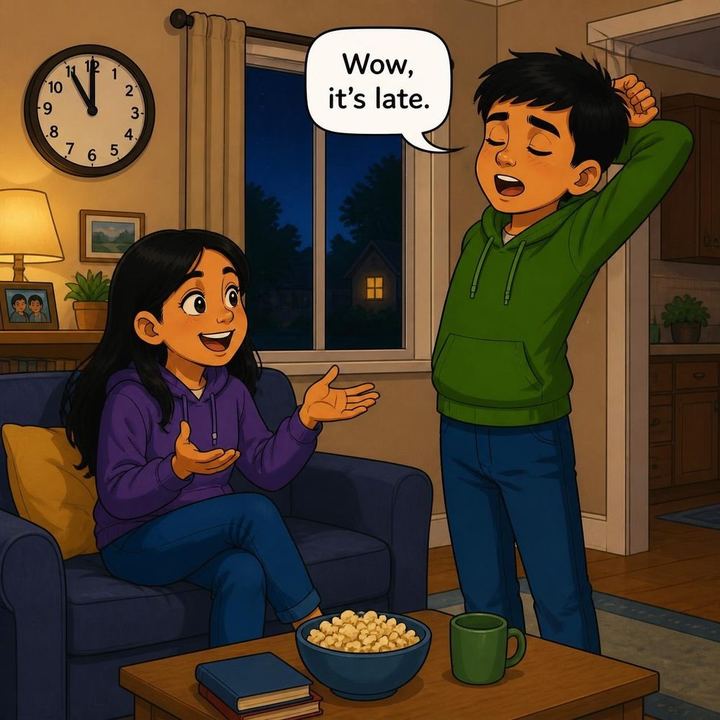
“Wow, it’s late.”
How to use this card
The words are about the clock. The meaning is about the door.
What’s happening
Nearly midnight by the clock on the wall. She is mid-story on the sofa with the popcorn still out. He has stood up, stretched, yawned, and said that it’s late.
Each side of it
Him He wants to go to bed and doesn’t want to say “please go home”, so he has pointed at the clock and hoped.
Her She has been handed a fact about the time. She agrees with it, and carries on with the story.
What to ask
- What has he actually said? What does he actually want?
- Which parts of his body are saying more than the sentence is?
- Why doesn’t he just ask her to go?
- What could she say to check, without it getting awkward?
- What could he say so that nobody has to guess?
Things you could say
- “Do you want me to get going?”
- “I’m going to have to kick you out — I’m shattered.”
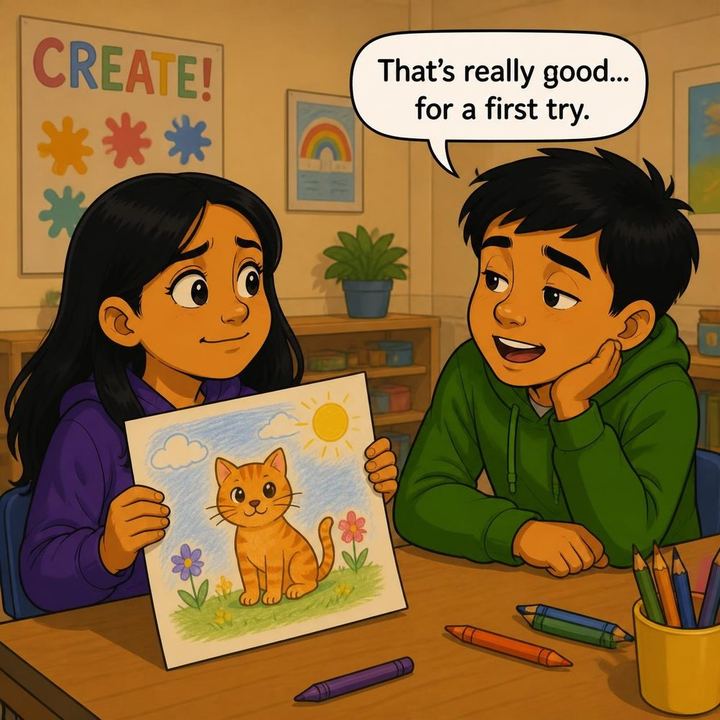
“That’s really good… for a first try.”
How to use this card
The second half is the half she’ll remember.
What’s happening
The art table. She is holding up a drawing she clearly cares about. He is leaning on his hand, being friendly, and has added three words to the end of the compliment.
Each side of it
Him He thinks he is encouraging her. In his head the sentence means “this is a promising start”.
Her She heard a compliment and then heard it taken back. The second half is the half that stays.
What to ask
- Read the sentence with the last three words. Now read it without them. Which would you rather be handed?
- Was he being unkind? Does that change where it landed?
- What was he trying to say? Say it again in a better way.
- What could she say if she wants his real opinion?
- What is the difference between being honest and adding a sting?
Things you could say
- “I like the cat’s face — how did you do the fur?”
- “Do you mean it’s good, or good for a beginner? I don’t mind which.”
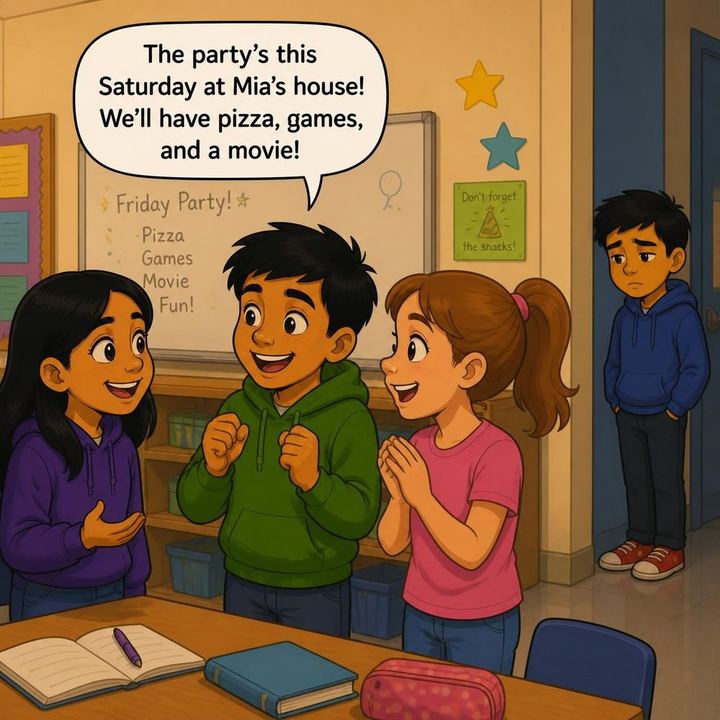
“I didn’t want to go anyway.”
How to use this card
Armour, not information.
What’s happening
A group is planning Saturday’s party out loud in the classroom, with the details already up on the whiteboard. A boy stands over by the door with his hands in his pockets, where nobody can see his face properly.
Each side of it
The group They are excited and not thinking about who can hear them. It hasn’t occurred to anyone that a list of what’s happening is also a list of who isn’t in it.
Him He minds a great deal. “I didn’t want to go anyway” is the sentence he will use if anybody asks him tomorrow.
What to ask
- Where is he standing, and why that spot?
- What will he say if someone asks him about the party? Will it be true?
- Why is that easier to say than the true thing?
- One person in that group could change his whole weekend. What would they have to do?
- What could he say if he wanted to be in it? What makes that hard to say?
Things you could say
- “Are you coming on Saturday? You should come.”
- “I’d actually really like to come, if that’s alright.”
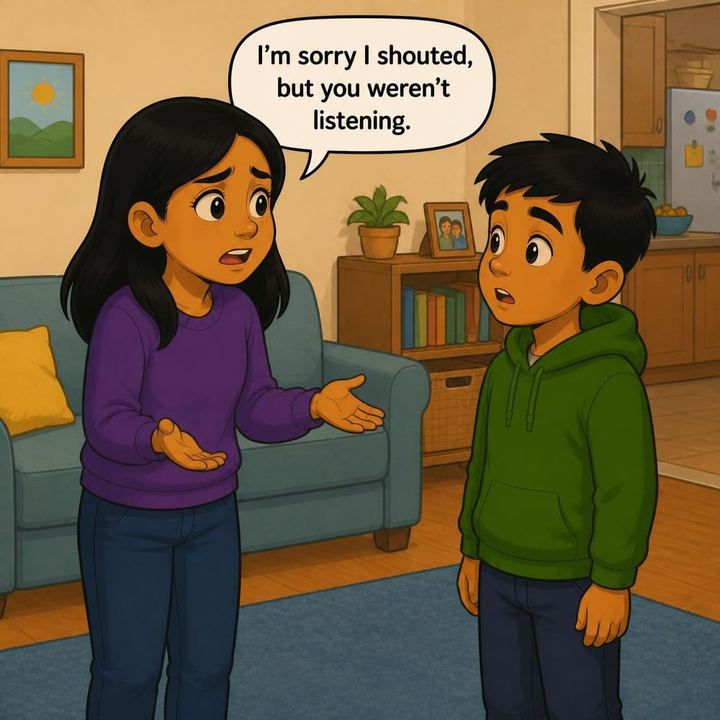
“I’m sorry I shouted, but you weren’t listening.”
How to use this card
A real apology can stand on its own.
What’s happening
A living room, straight after a row. She is apologising with her hands open. There is a “but” in the middle of the sentence, and everything after it is about him.
Each side of it
Her She is sorry about the shouting, and she also wants it understood that there was a reason. Both are true, so she has put them in one sentence.
Him He was given an apology and then an explanation of why it was his fault. The apology has gone.
What to ask
- Find the “but”. What comes after it?
- Has she apologised? Fully? Partly?
- What else is she trying to say — and is that a fair thing to want?
- Could both things be said if they were two separate sentences, with a gap in between?
- How does it feel to be given an apology with a reason attached to the end?
Things you could say
- “I’m sorry I shouted. That wasn’t okay.” — and nothing else, for now.
- Later: “Can I tell you what was going on for me?”
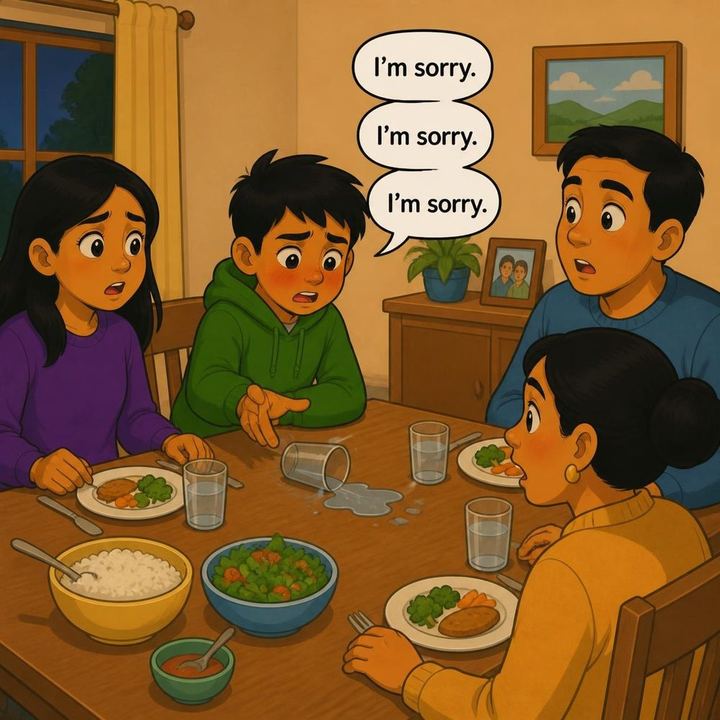
“I’m sorry. I’m sorry. I’m sorry.”
How to use this card
A pause is not a verdict.
What’s happening
Family dinner. A glass has gone over and water is spreading across the table. He is apologising three times over and watching everybody’s faces. Nobody has actually said anything yet.
Each side of it
Him The silence while people react is the worst part of it, and the apologies are filling the silence. He is checking whether he is still alright with everyone.
The rest of the table They are surprised about the glass and rather more surprised by the number of sorries. Nobody was cross.
What to ask
- What has actually happened here? How big is it, out of ten?
- Why has he said it three times rather than once?
- What is he waiting to hear?
- What happens in the gap before people answer? Does the gap mean anything?
- What could somebody at that table say to end this quickly?
Things you could say
- “It’s only water. Grab a cloth.”
- “One sorry is plenty — it was an accident.”
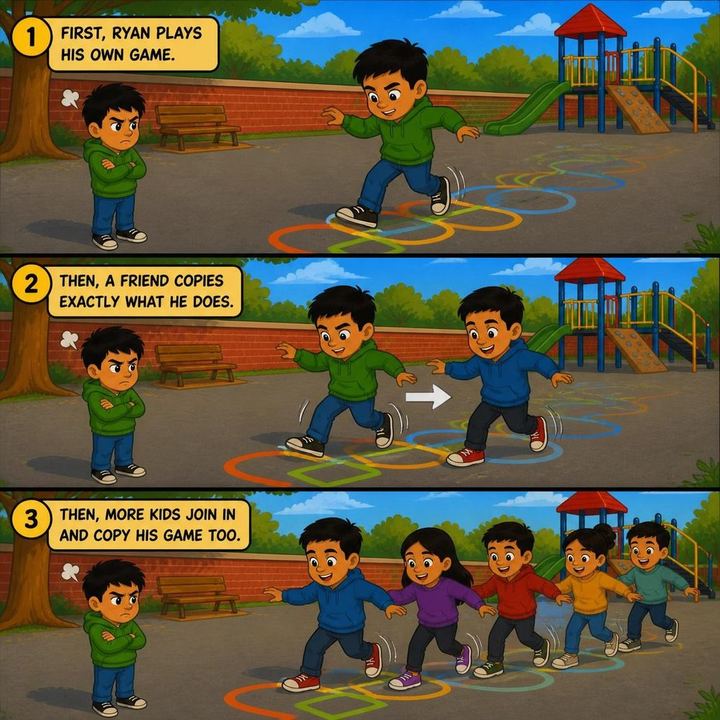
“It was my game.”
How to use this card
The game didn’t leave him. He stepped out of it.
What’s happening
Three panels. Ryan invents a game on the playground markings. A friend copies it exactly. Then more children join in and it becomes everybody’s game. In all three panels Ryan is over by the tree with his arms folded.
Each side of it
Ryan He made it up, and now there is a crowd playing it without him. From where he’s standing it looks as though it was taken.
The others Copying it was the compliment. They are playing his game because it was a good one, and as far as they know he can join back in at any moment.
What to ask
- What did Ryan invent?
- What did the others do with it?
- Is copying stealing here? What else could it mean?
- What is actually stopping him walking back over there?
- What could he say to get his game back — and what could they say to him?
Things you could say
- “Oi, I made this up — budge over.”
- “Ryan, come on, show them the next bit.”
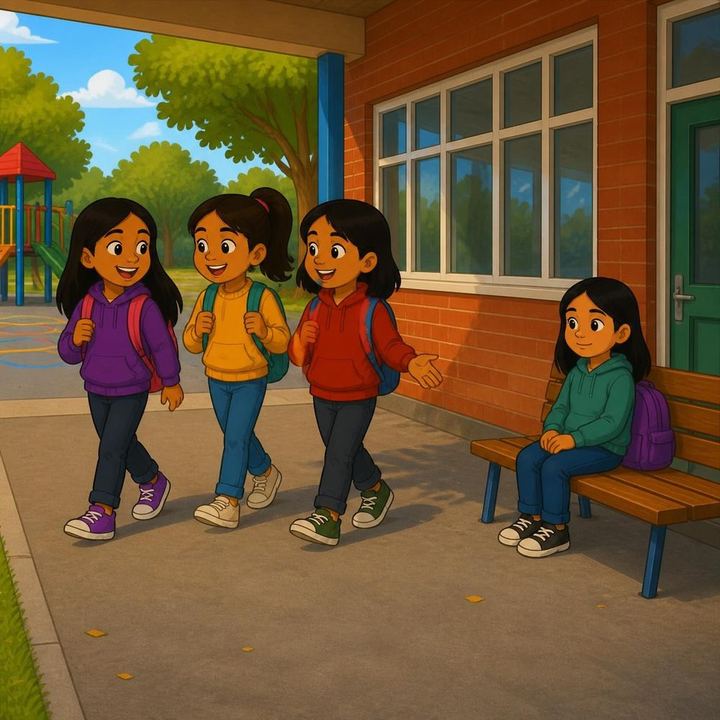
“They walked straight past.”
How to use this card
Being not-noticed and being ignored look identical from the bench.
What’s happening
The end of the day outside school. Three girls walk past together, deep in conversation. A girl sits on the bench with her bag and watches them go. Nobody looked over.
Each side of it
Her From the bench, three friends looked straight through her and kept walking.
Them Mid-conversation, eyes on each other, heading somewhere. It is entirely possible they never saw her at all.
What to ask
- Where is everybody looking?
- Did anybody in this picture make a decision about her?
- What is the difference between being ignored and not being seen? Can you tell from the bench?
- What could she do that would find out for certain?
- Have you ever been one of the people walking past without noticing?
Things you could say
- “Hiya — where are you lot off to?”
- “We didn’t see you sat there! Come with us.”
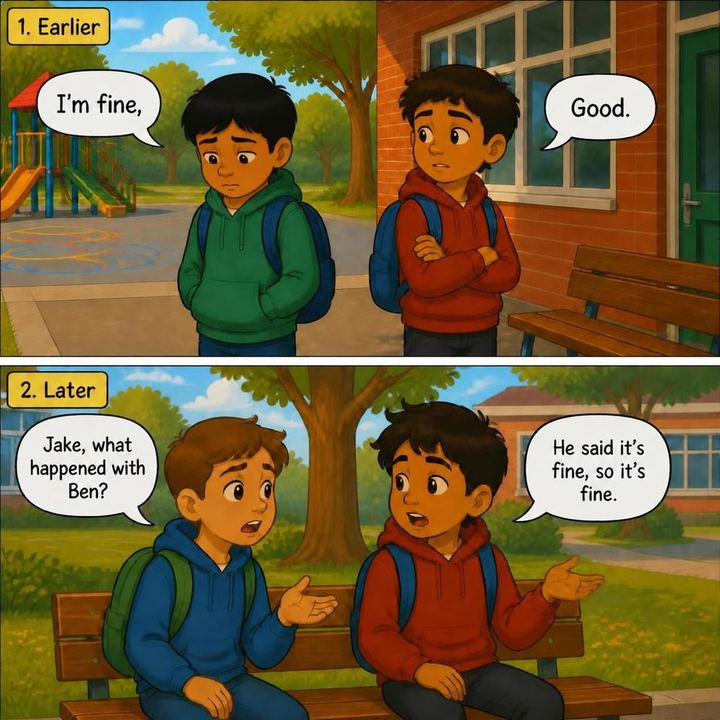
“He said it’s fine, so it’s fine.”
How to use this card
Ask twice, then believe them.
What’s happening
Two panels. Earlier: Ben says “I’m fine” while looking anything but, and Jake, arms folded, says “Good.” Later, on a bench, somebody asks Jake what happened with Ben, and Jake says the words settled it.
Each side of it
Ben “I’m fine” is the thing you say. He would have needed a second question before he said anything else.
Jake He asked, he got an answer and he took the answer. He isn’t being cold; he is being literal.
What to ask
- Look at Ben’s face in the first panel. Does it match his words?
- Was Jake wrong to believe him?
- Why do people say “I’m fine” when they aren’t?
- What’s a good second question? Not “are you sure?” — something better than that.
- When have you said “I’m fine” and wanted to be asked again?
Things you could say
- “You don’t look fine. I’m not going anywhere.”
- “Fine like fine, or fine like I’ll tell you later?”
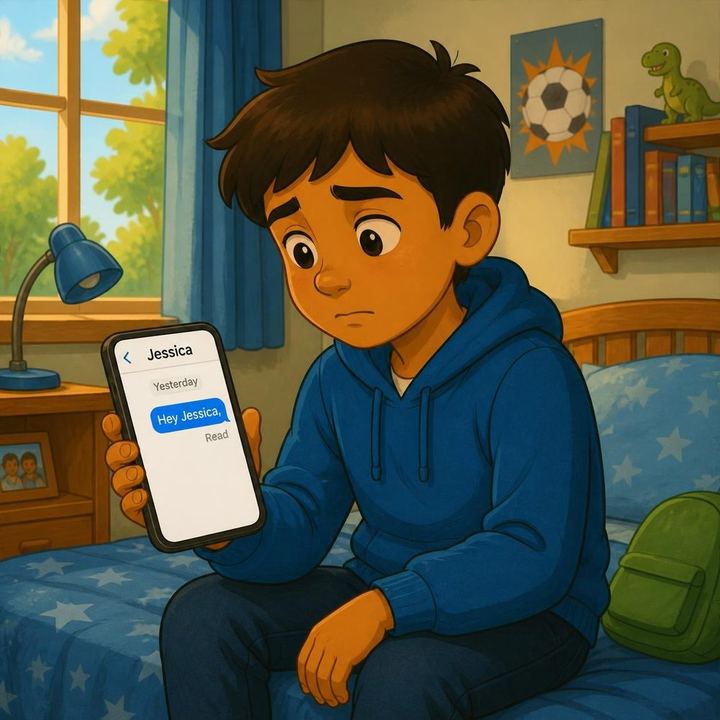
“Read.”
How to use this card
It tells you about a screen, not about a person.
What’s happening
His bedroom. He sent “Hey Jessica,” yesterday. Underneath it the screen says Read. There has been nothing since, and he is still holding the phone.
Each side of it
Him The word Read is proof that she saw it and chose not to answer. He has been carrying that for a day.
Jessica She opened it, meant to reply, and then something else happened. She may not know the word is even showing.
What to ask
- What does the phone actually know? What can it never know?
- How long has he been holding this? What has it cost him?
- How many harmless reasons are there for no reply?
- What would happen if he simply sent another message?
- Have you ever left somebody on read by accident?
Things you could say
- “You’re not ignoring me are you? No pressure.”
- “Sorry! Opened it and got distracted. Classic me.”
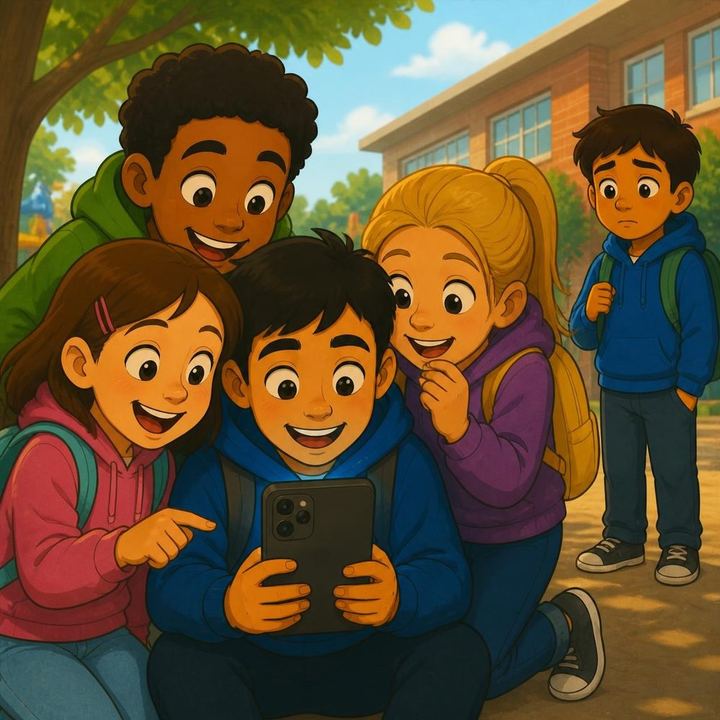
“They’re laughing.”
How to use this card
Where are their eyes? That’s the whole test.
What’s happening
A group is crowded round a single phone outside school, all of them laughing at whatever is on it. A boy stands a few feet away watching them, and his face has already decided what the laughing is about.
Each side of it
Him A group is laughing near him and the only explanation he can find involves himself.
Them Every single one of them is looking at the screen.
What to ask
- Where is everyone looking?
- Does anybody in that group look at him, even once?
- So what is the laughing about?
- How could he check, in one sentence?
- What does it feel like to walk past a laughing group? Does feeling it make it true?
Things you could say
- “What’s funny? Show me.”
- “Come and look at this — it’s ridiculous.”
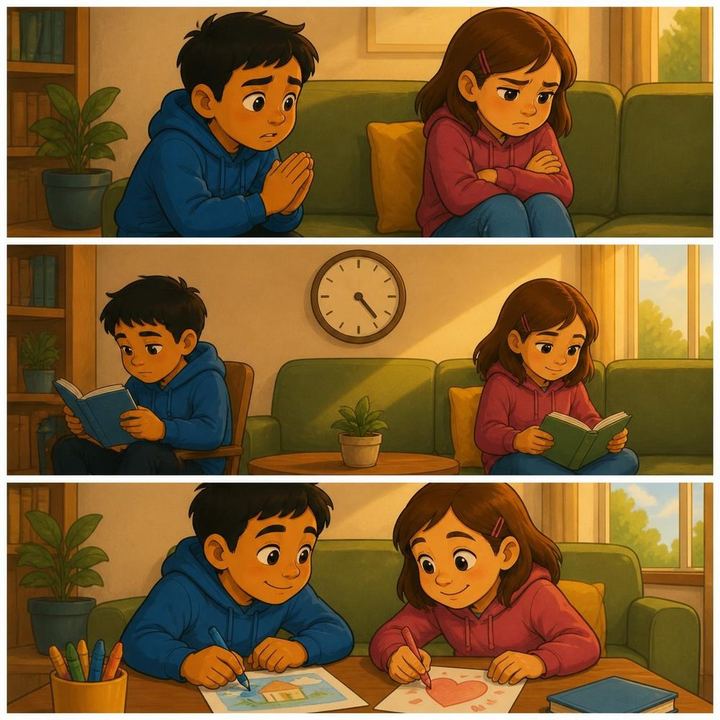
“The bit in the middle.”
How to use this card
Words are instant. Feelings aren’t.
What’s happening
Three panels. First, the falling-out — he’s pleading, she’s turned away with her arms folded. Second, a while later, the two of them reading quietly in the same room. Third, drawing together at the table, fine again.
Each side of it
Him He apologised, it didn’t work immediately, and he assumed that meant it hadn’t worked at all.
Her She accepted the apology and still needed the middle panel. The feeling drains at its own speed, not at the speed of the words.
What to ask
- What happens in panel two? Almost nothing — so why is it in the picture?
- Did the apology work? When did it work?
- What might he think is happening during the middle bit?
- What could either of them say so the gap doesn’t become frightening?
- How long does it take you to come round after a row?
Things you could say
- “I’m not cross any more. I just need a bit.”
- “I’ll be over here when you’re ready.”
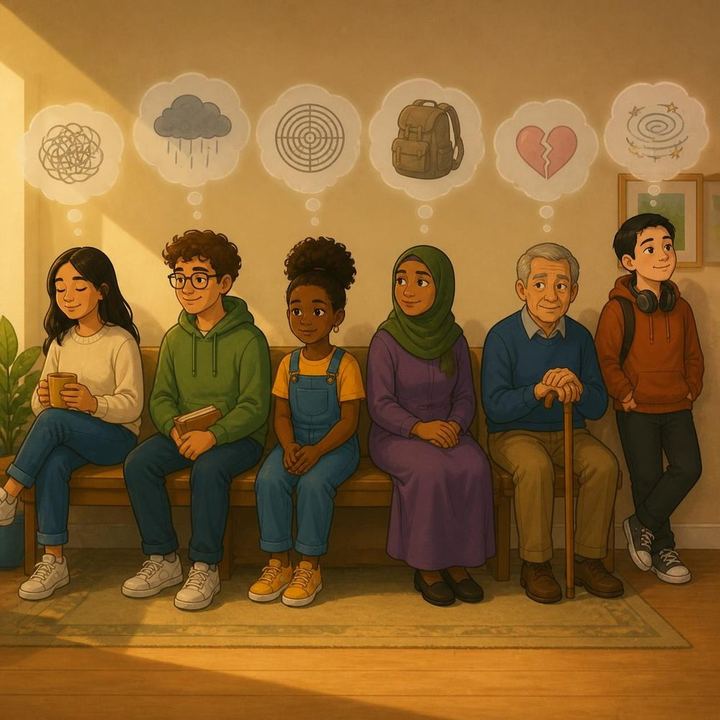
“Everyone else finds this easy.”
How to use this card
You compare your inside to everybody else’s outside.
What’s happening
Six people on a bench, all ages, every face composed and calm. Above each one is a thought bubble: a knot of tangles, a rain cloud, a spiral, a heavy bag, a broken heart, a head full of stars.
Each side of it
Any one of them Looks along the bench, sees five calm faces, and concludes they are the only one struggling.
All six of them Are doing exactly that, at the same moment, on the same bench.
What to ask
- Which face on that bench looks like it’s having the hardest time?
- Now look at the bubbles. Did the faces tell you anything at all?
- What is every person on that bench getting wrong about the others?
- If one of them said something out loud, what might happen to the other five?
- What’s in your bubble that nobody can see from the outside?
Things you could say
- “Is it just me finding this hard?”
- “No — same. I’ve just got a calm face.”
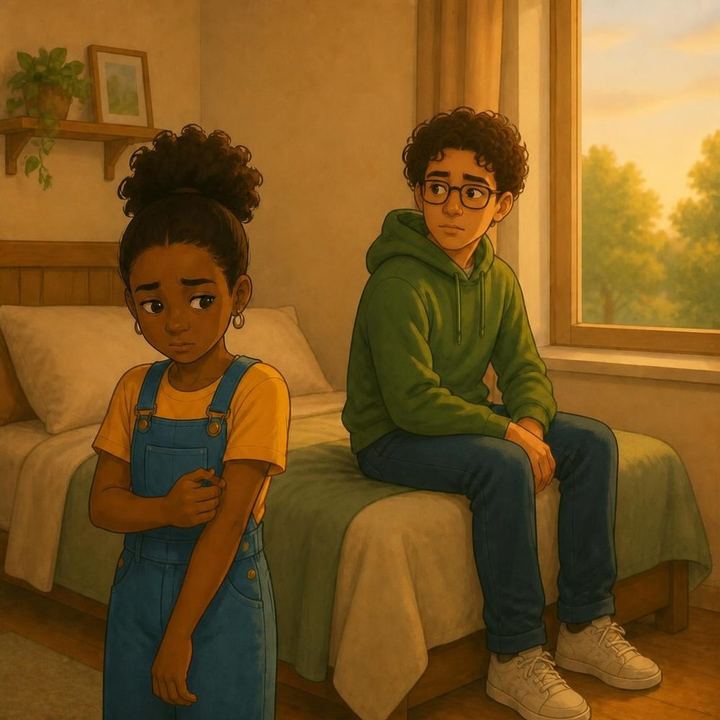
“He’s staring at me.”
How to use this card
A blank face means absence, not opinion.
What’s happening
A bedroom. She is standing up, uneasy, fiddling with her sleeve. He is sitting on the bed with a completely neutral expression, pointed roughly in her direction.
Each side of it
Her A blank face aimed at her reads as a judgement, and she is filling it in with something bad.
Him He isn’t looking at her. He is somewhere else entirely and his face has simply switched off.
What to ask
- What is his face doing? Now say what it is not doing.
- Where do you think he actually is?
- Why do we read a blank face as a bad face rather than an empty one?
- What could she ask that wouldn’t be awkward?
- What does your face do when you’re thinking? Do people get it wrong?
Things you could say
- “You’ve gone quiet — are you alright, or just thinking?”
- “Sorry, I was miles away. It wasn’t about you.”
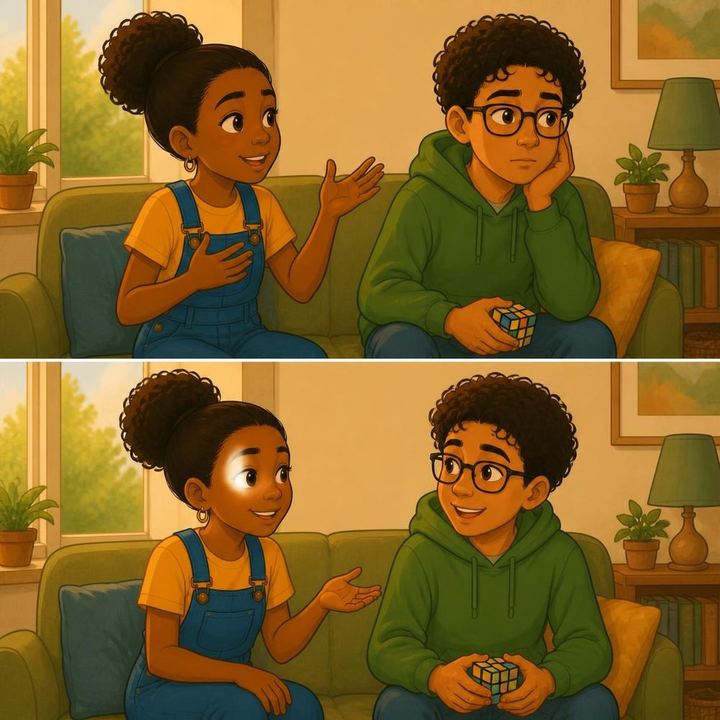
“I went on too long.”
How to use this card
Attention runs out before affection does.
What’s happening
Two panels. She is mid-flow about something she loves; he is propped on his hand, glazed over, turning a cube. In the second panel they are both animated and laughing, and the cube is still in his hands.
Each side of it
Her She saw the glazed face in the first panel and decided she had ruined it — that he’d had enough of her.
Him His attention ran out for a few minutes. Then it came back. He hadn’t gone anywhere.
What to ask
- What is his face doing in the first panel? And in the second?
- What changed between them?
- What did she think the first face meant?
- Is running out of attention the same as running out of interest?
- What could either of them say when the drifting starts?
Things you could say
- “Stop me if I’m going on — I do go on about this.”
- “Sorry, I zoned out. Say that last bit again.”
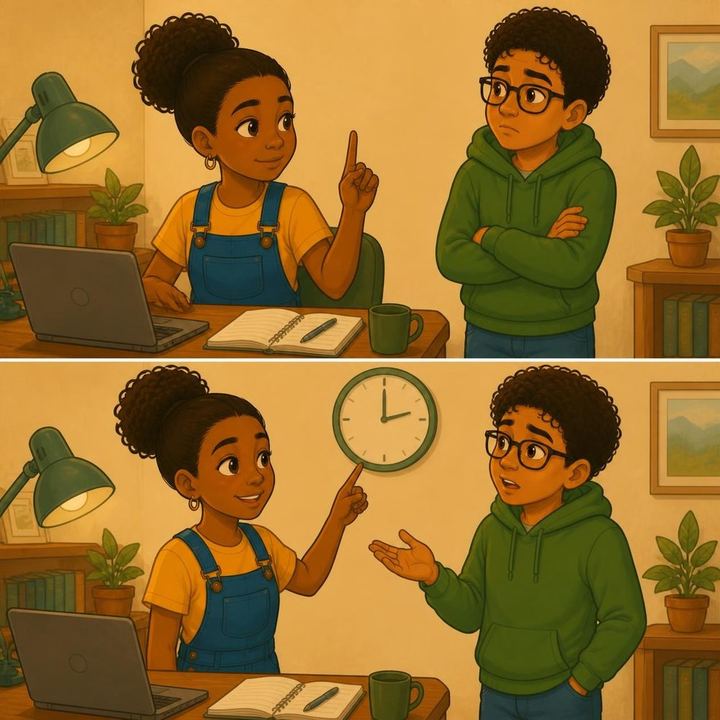
“One sec.”
How to use this card
A number in conversation is a mood, not a measurement.
What’s happening
Two panels. She holds up one finger without looking away from the laptop. He waits with his arms folded. In the second panel the clock has moved on considerably and the finger is still up.
Each side of it
Her “One sec” meant “I’m nearly at a stopping point”. It was never a number, and she has no idea how long it has been.
Him He was given a measurement, and he has been counting ever since.
What to ask
- How long is “one sec”? What does the clock say it was?
- Did she lie?
- What was she actually telling him?
- What could she have said that he could have used?
- What could he say after five minutes that isn’t a complaint?
Things you could say
- “Give me till the end of this bit — about five minutes.”
- “Are we still on one sec, or is it a proper wait? I’ll go and do something.”
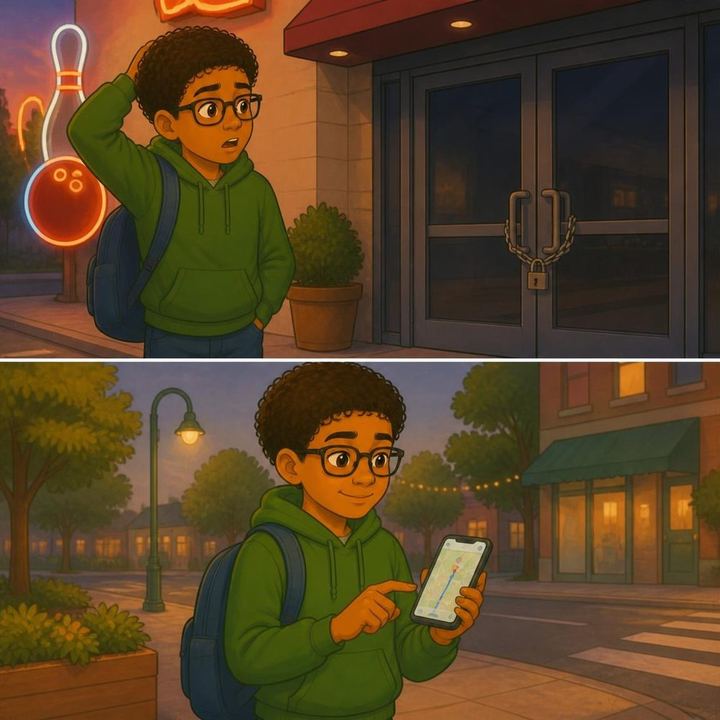
“The bowling alley’s shut.”
How to use this card
A plan is a picture of what’s coming.
What’s happening
Two panels. He arrives at the bowling alley and the doors are chained shut. He has stopped dead with a hand on his head. In the second panel he is on the map on his phone, working out what else is nearby.
Each side of it
Panel one The plan was a picture of the whole evening, and the picture has gone. That is a real loss and it happens all at once.
Panel two The same evening, rebuilt — but only once there was something to rebuild it out of.
What to ask
- What is his hand doing in the first panel?
- What has actually been lost — bowling, or the picture of the evening?
- What happened between panel one and panel two?
- Which helps more in the gap: somebody saying “it doesn’t matter”, or somebody offering three other things?
- What’s your plan B usually?
Things you could say
- “It’s shut. Give me a minute — I’m annoyed.”
- “Right. Cinema, chips, or home? Pick one.”
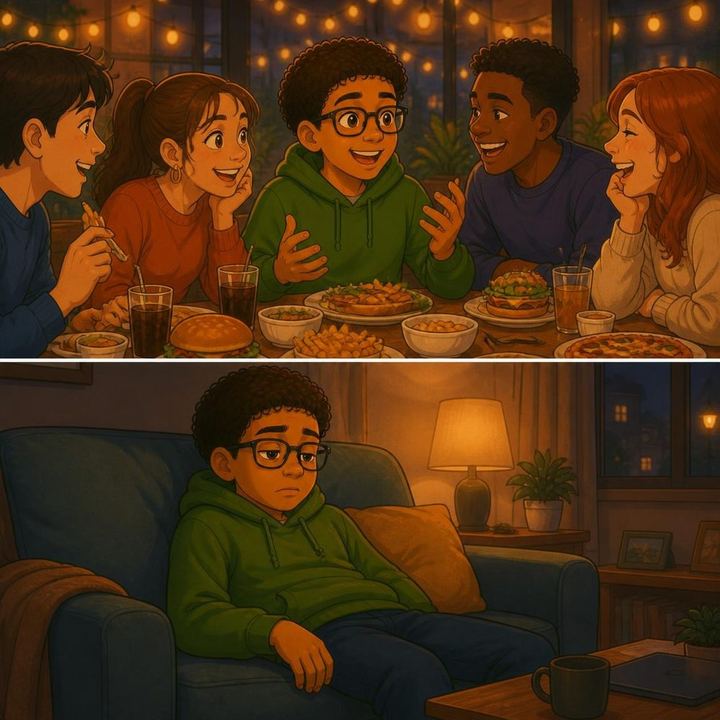
“It was a good night.”
How to use this card
Panel two is the bill for panel one.
What’s happening
Two panels. Dinner with five friends, lights strung overhead, and he is right in the middle of it, talking and laughing. Then home on the sofa, on his own, completely flattened.
Each side of it
In the restaurant Nothing was wrong. He wasn’t pretending and he enjoyed every minute of it.
On the sofa The same evening is being paid for. The tiredness is not a verdict on his friends.
What to ask
- Is he unhappy in the first panel? Really?
- So what has happened by the second one?
- Can something be completely worth it and still cost a lot?
- What does he need for the rest of the evening? What definitely won’t help?
- What do you need after a big day?
Things you could say
- “Loved tonight. I’m going to be useless tomorrow.”
- “I’m not sad, I’m just empty. I’ll be fine in the morning.”
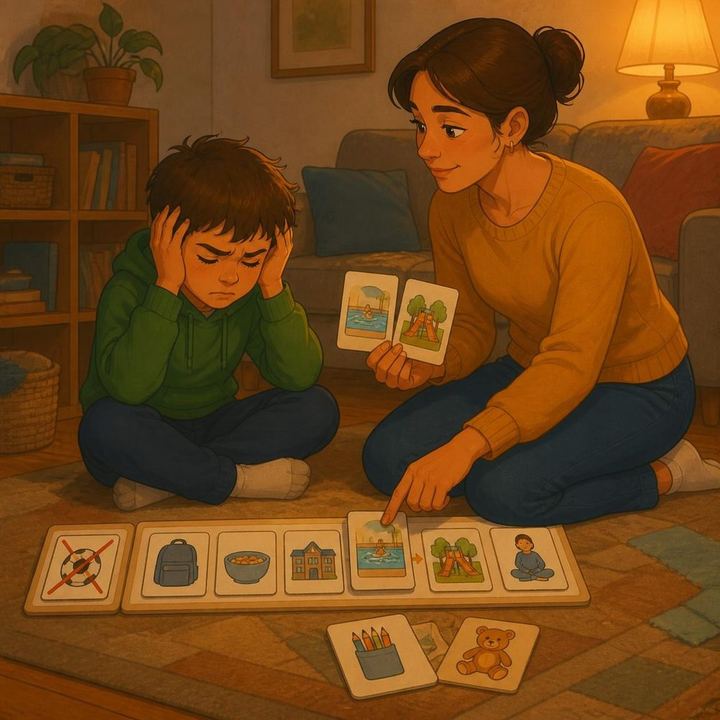
“The card with the cross on it.”
How to use this card
Crossed out, and still there.
What’s happening
The visual timetable is out on the floor. Swimming has been crossed through in red and left sitting in the row. Mum is holding up two alternatives. He has his hands over his ears and his eyes shut.
Each side of it
Him The crossed-out card is still in the line. Swimming is still on the board, still in the plan and still in his head, only now with a line through it. The cross hasn’t removed anything.
Her She has crossed it off and offered two perfectly good alternatives, and she can’t understand why neither of them is landing.
What to ask
- Which card has the cross on it? Is it still on the timetable?
- What does the cross tell him? What does it fail to do?
- What might happen if that card were taken off the strip completely?
- Is he refusing the new choices, or has he not got as far as them yet?
- What order would help — remove it, wait, then offer?
Things you could say
- “Swimming’s off today. I’m taking that card away.”
- After a wait: “When you’re ready, there are two other things we could do.”
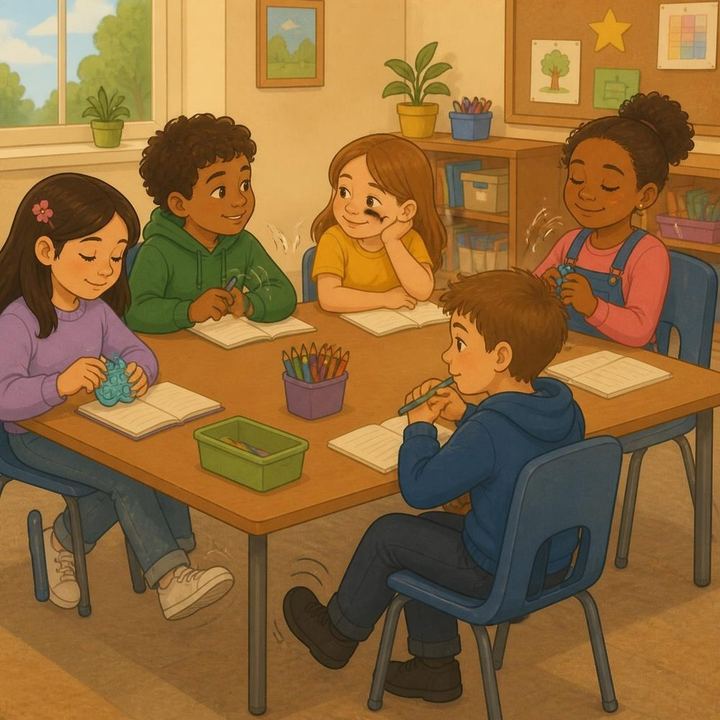
“Everyone’s doing it.”
How to use this card
Same function. Different label.
What’s happening
A classroom table where every single person is regulating themselves — a squishy toy, a fidget, a pen being chewed, a chair being rocked, hair being twisted. Everybody is calm, and everybody is working.
Each side of it
The ones nobody mentions Chewing a pen and bouncing a knee don’t have a name. They pass without comment.
The one who gets noticed Doing the identical job with a different movement, which does have a name, and sometimes gets stopped.
What to ask
- Go round the table. What is each person doing with their hands, mouth or feet?
- What are all of those things for?
- Which ones would get a comment from an adult, and which wouldn’t?
- Why those ones?
- What would happen to the work on that table if all of it were banned?
Things you could say
- “This helps me listen.”
- “Everyone here is doing something. Mine’s just easier to see.”
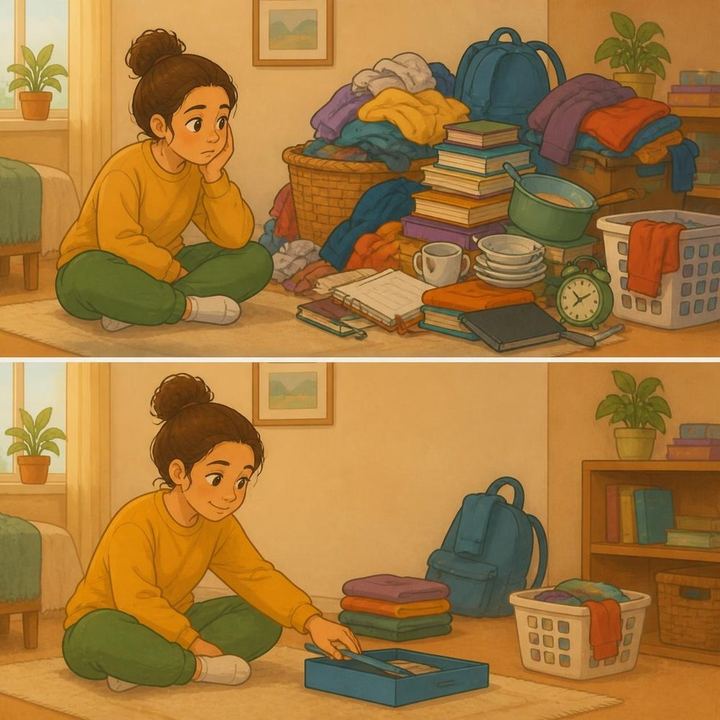
“I know what I need to do.”
How to use this card
Starting is a separate skill from wanting or knowing.
What’s happening
Two panels. She is sitting in the middle of all of it — washing, dishes, books, a clock ticking — with her chin in her hand, not moving. In the second, the room is mostly clear and she is calmly sorting one small box.
Each side of it
Panel one She knows exactly what needs doing. She could list every item. Knowing is not the part that’s missing.
Panel two Something started. Once it had started, it kept going.
What to ask
- Does she know what needs doing in the first picture?
- So what is actually missing?
- What is the smallest possible thing she could pick up?
- Is “just start” useful advice? What would be more useful?
- What gets you going when you’re stuck at the edge of a job?
Things you could say
- “I’m not being lazy. I can’t get started.”
- “Shall I do the first two minutes with you?”
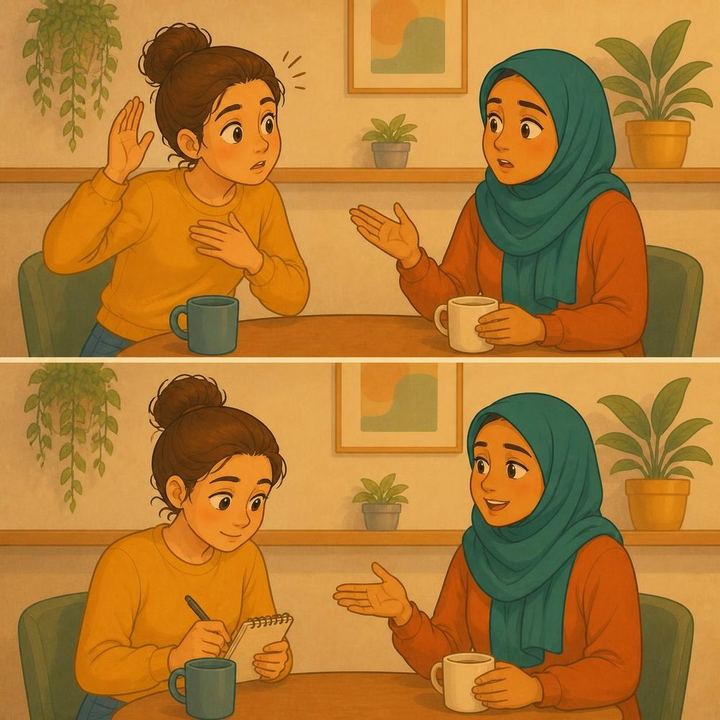
“Sorry — I’ll forget it.”
How to use this card
The thought doesn’t need saying. It needs somewhere to live.
What’s happening
Two panels in a café. In the first she has her hand up to interrupt, because something has arrived in her head and won’t survive the wait. In the second she has written it on a pad and is listening properly.
Each side of it
Her Interrupting isn’t rudeness here, it’s a rescue attempt. The thought genuinely will be gone in twenty seconds.
Her friend Mid-sentence, and getting stopped, without being told why.
What to ask
- Why has she put her hand up?
- What is she frightened of losing?
- What does the second picture solve?
- Is interrupting always rudeness? What else can it be?
- What could she say so her friend knows what’s happening?
Things you could say
- “Hang on — let me write that down or it’s gone.”
- “I’m not ignoring you, I’m saving a thought.”
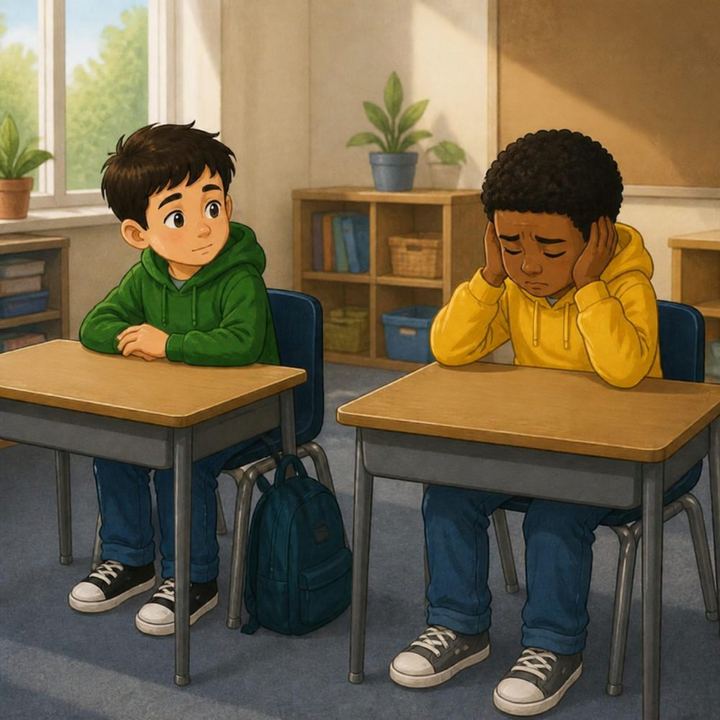
“I want to help but I don’t know how.”
How to use this card
The help is subtraction.
What’s happening
A classroom. One boy has his head in his hands, completely overloaded. The boy at the next desk has turned towards him, wants to do something, and is doing nothing — because nothing obvious presents itself.
Each side of it
The boy in yellow Anything added right now — a question, advice, a hand on the shoulder, a bright voice — is one more thing to process.
The boy in green Everything he can think of is an addition, so he is stuck, and feels useless for it.
What to ask
- What is the boy in yellow doing with his hands? What is he shutting out?
- What would talking to him add right now?
- What could be taken away instead? Name three things.
- Is doing nothing the same as not helping?
- What do you want people to do when you feel like that?
Things you could say
- “I’m here. You don’t have to talk.” — and then nothing else.
- To the room: “Leave him a minute.”
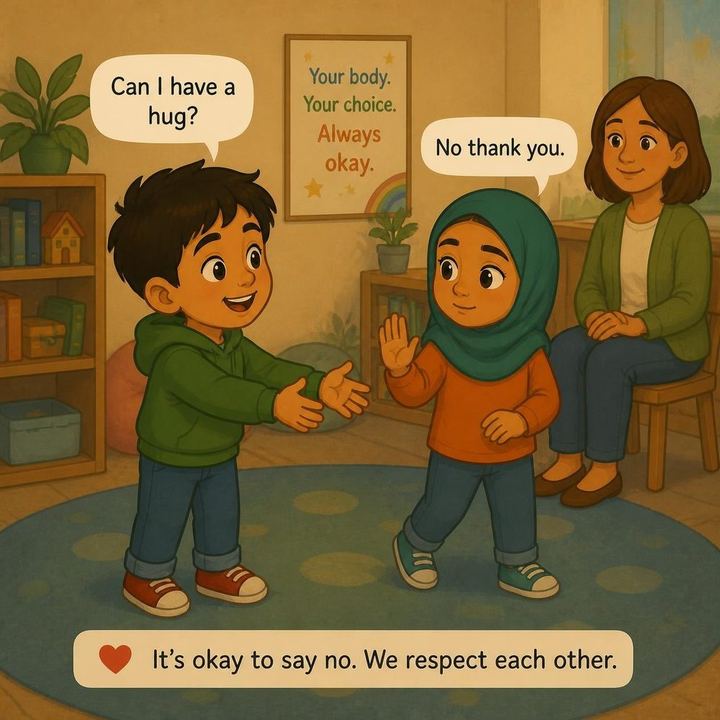
“No thank you.”
How to use this card
Asking only counts if no is a real answer.
What’s happening
A playroom. He has asked for a hug with his arms already half out. She has said no thank you, with a hand up. The adult across the room has stayed where she is. The poster on the wall says it’s her choice.
Each side of it
Him He asked, which was the right thing to do, and the answer wasn’t the one he expected. That is disappointing, and it isn’t a rejection of him.
Her She was asked, she said what was true, and that only works if it is allowed to be the end of it.
What to ask
- What did he do right?
- What did she do right?
- What would happen to the question if “no” weren’t allowed?
- How might he be feeling? Is it alright to feel that and accept the answer anyway?
- What could he say next that leaves them both fine?
Things you could say
- “Okay. High five instead?”
- “Not right now, thanks — maybe later.”
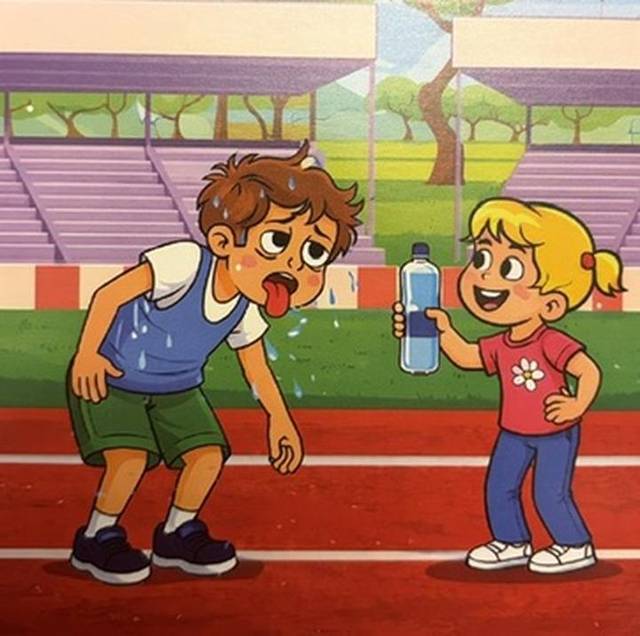
“He didn’t ask for it.”
How to use this card
Some needs are visible before they’re spoken.
What’s happening
He has stopped mid-session, bent over, red in the face and not yet breathing properly. She has walked over with a bottle already held out. Nothing has been said by either of them.
Each side of it
Him He is too out of breath to ask for anything, and he isn’t thinking about how he looks from the outside.
Her She watched him run, saw the state of him at the end of it, and worked out what he needed without being told.
What to ask
- What has the boy been doing just before this? Which bits of the picture tell you?
- He hasn’t said a word. So how does she know what he wants?
- What might he be feeling about being handed something without asking?
- What could he say once he has his breath back?
- When has somebody noticed what you needed before you said it?
Things you could say
- “Here — you looked like you needed this.”
- “Thanks. I couldn’t even talk.”
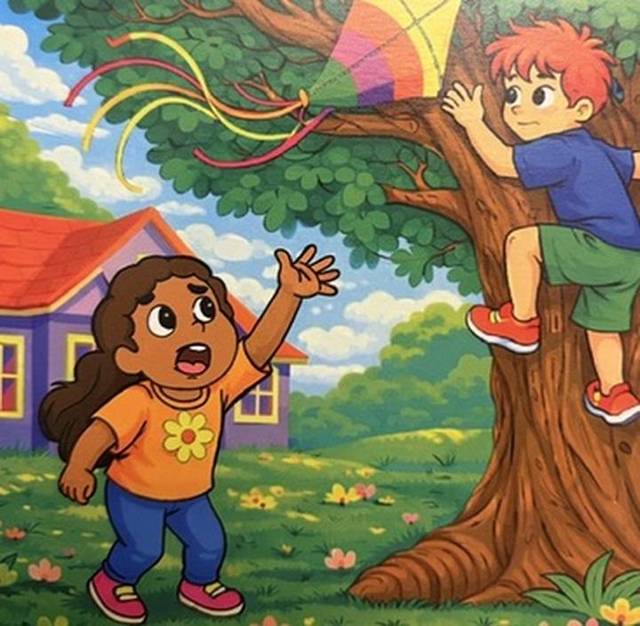
“I’ll just get it down.”
How to use this card
Worried and cross look identical from the bottom of a tree.
What’s happening
The kite is caught high in the branches. He is already several feet up the trunk. She is on the ground with both arms in the air and her mouth open.
Each side of it
Him The kite is the problem and he is the one solving it. He can see a route up and he is taking it.
Her He is now higher than she can reach and the branch is thin. Her face and her voice have both gone sharp, because she is frightened.
What to ask
- Is she telling him off, or is she frightened? What in the picture made you choose?
- What is he thinking about — the kite, or the branch he’s standing on?
- He thinks he’s solving the problem. She thinks he’s becoming one. Who is right?
- What could they do instead? Who could they fetch?
- How do you tell somebody to stop without it sounding like a telling-off?
Things you could say
- “Come down — I’d rather lose the kite than you fall.”
- “Wait there. I’m getting someone tall.”
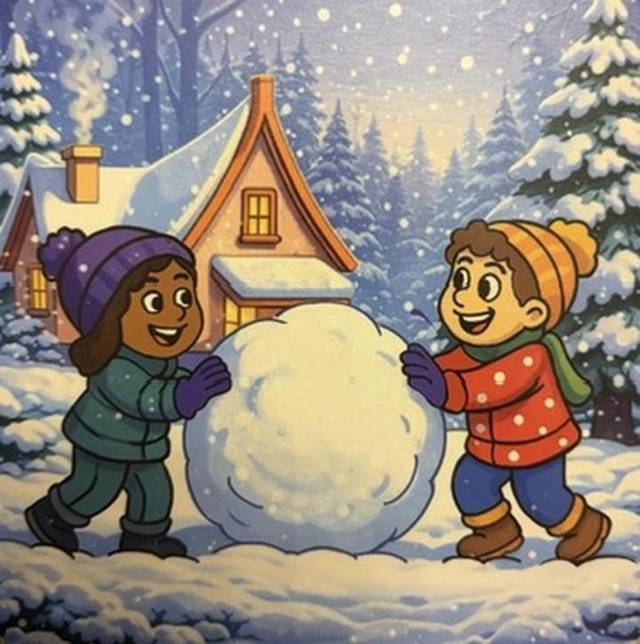
“It’s too big for one.”
How to use this card
Some jobs are the reason people become friends.
What’s happening
One snowball, two children, four hands, both pushing the same way. It is already bigger than either of them could move alone.
Each side of it
What’s working They have matched their pushing without discussing it. Neither has claimed the snowball as theirs, and neither is waiting to be thanked.
What to ask
- How can you tell they’re working together rather than fighting over it?
- What would happen if one of them let go without saying anything?
- Who decides which way the snowball goes? How would they agree that?
- What’s something you can’t do on your own, however hard you try?
- What could one of them say to keep the other one going?
Things you could say
- “Push on three — one, two, three.”
- “Can we stop a sec? My arms have gone.”
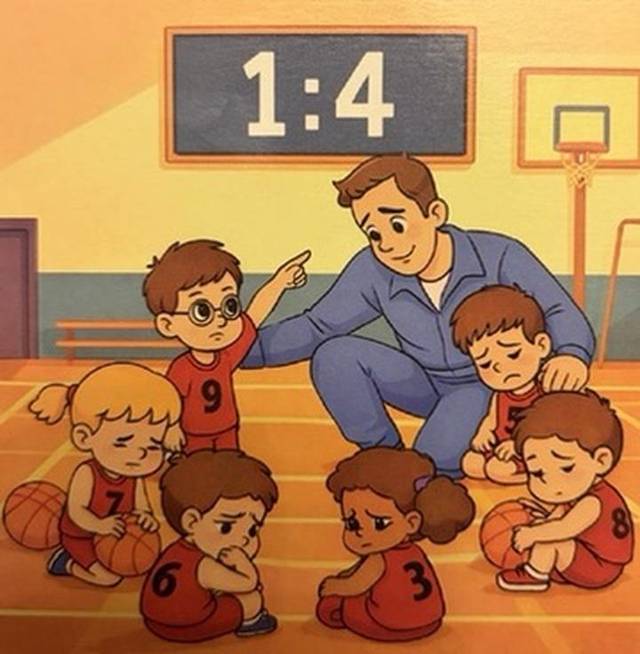
“It was his fault.”
How to use this card
Blame is what disappointment does when it needs somewhere to go.
What’s happening
The scoreboard reads one to four. The team is on the floor at the end of the match. One boy is pointing at the boy in glasses, and the coach has come down to their level.
Each side of it
The boy pointing He has just lost and the feeling needs somewhere to go. One person is easier to blame than a whole afternoon.
The boy in glasses He already suspects it was his fault. The finger makes it official, and now everyone is looking.
What to ask
- Look at the scoreboard first. What’s just happened?
- Go round the group — what is each child feeling? Are they all feeling the same thing?
- What is the boy doing with his disappointment by pointing?
- Does pointing change the score?
- What could the coach say? What could the pointed-at boy say?
Things you could say
- “I hate losing. I’m not actually cross with you.”
- “We lost it together. Same next week.”
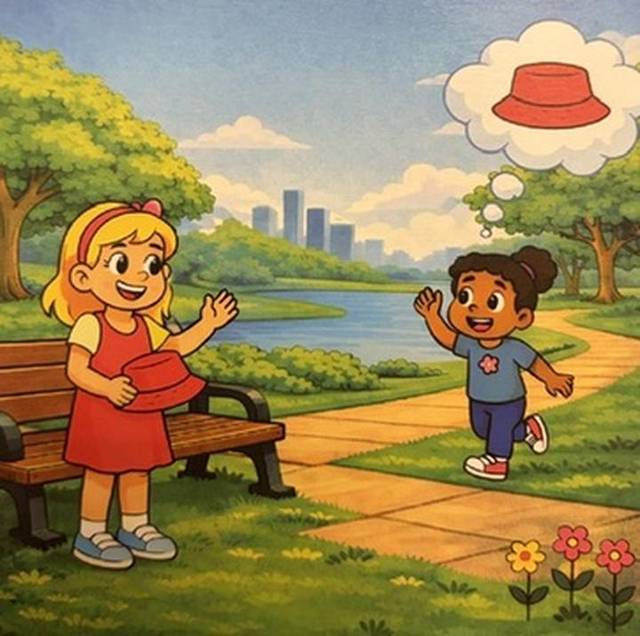
“She found my hat.”
How to use this card
Two people can be delighted about completely different things.
What’s happening
She is standing by a bench holding a red hat above her head and waving. He is running towards her, and the thought bubble above him contains the hat — not her.
Each side of it
Him He lost something and now it is found. The relief he is feeling is about the object.
Her She has been holding it, waiting for him, pleased to be the one who found it. She is expecting a bit of a moment.
What to ask
- There’s a thought bubble. Whose thought is it, and what’s in it?
- Is he running towards the hat or towards her? Does it matter?
- Why is she smiling — is it about the hat at all?
- What will he say first? What else is worth saying?
- How would she feel if he grabbed it and ran off without a word?
Things you could say
- “You found it! Thank you — I looked everywhere.”
- “I saw it on the bench and thought it was yours.”
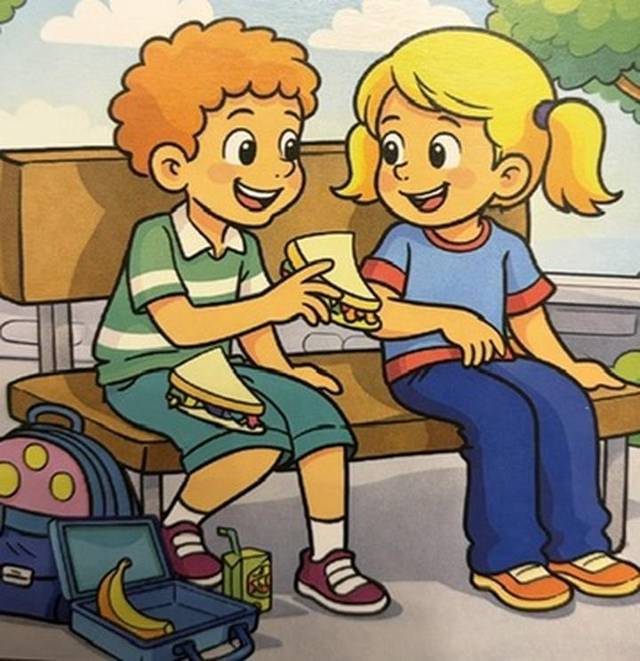
“Do you want half?”
How to use this card
An offer isn’t a swap.
What’s happening
Two children on a bench with an open lunchbox. He has split his sandwich and is holding half of it out. She never asked for any.
Each side of it
Him He wasn’t hungry enough for all of it and thought she might want some. It cost him very little to offer.
Her She now has to decide, in front of him, whether to take it — and whether saying no will look ungrateful.
What to ask
- What has he decided to do, and did anyone ask him to?
- Why might somebody share when they didn’t have to?
- If she says “no thanks”, has he done something wrong?
- Does he now get something back? Should he expect to?
- How would you offer something? How would you turn one down kindly?
Things you could say
- “I’ve got loads — do you want half?”
- “No thanks, I’ve got mine. That was kind though.”
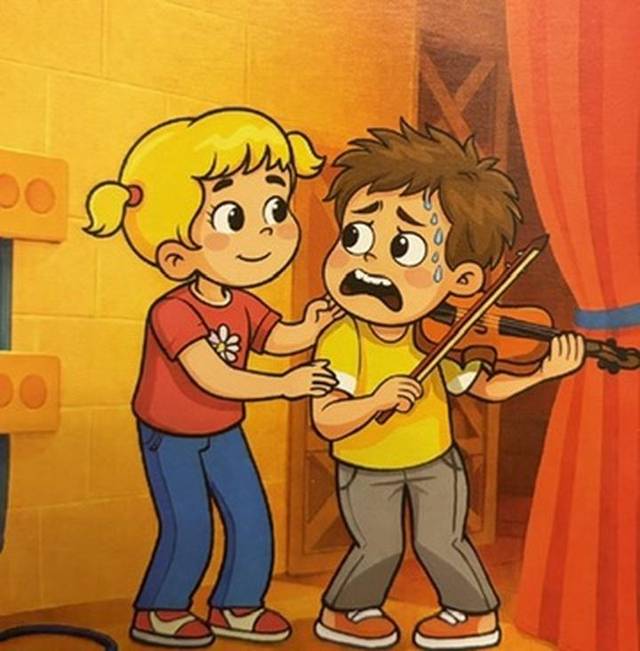
“You’ll be fine.”
How to use this card
Reassurance doesn’t remove the feeling. Company sometimes does.
What’s happening
Backstage, next to the curtain. He is gripping the violin too tightly and sweating. She has put a hand on his shoulder and said something encouraging.
Each side of it
Him His body has decided this is dangerous. Being told that it isn’t does not reach the part that made the decision.
Her She can see he’s struggling and wants to fix it, and “you’ll be fine” is the only sentence she has to hand.
What to ask
- Which parts of him show he’s nervous? Start with his face, then his hands.
- Does being told “you’ll be fine” make nerves stop?
- She’s put a hand on his shoulder. Is that doing more than the words are?
- What might actually help him in the next two minutes?
- When you’re nervous, do you want someone chatting to you or standing quietly nearby?
Things you could say
- “I’ll be right at the side the whole time.”
- “Do you want me to talk, or shall I just stand here?”
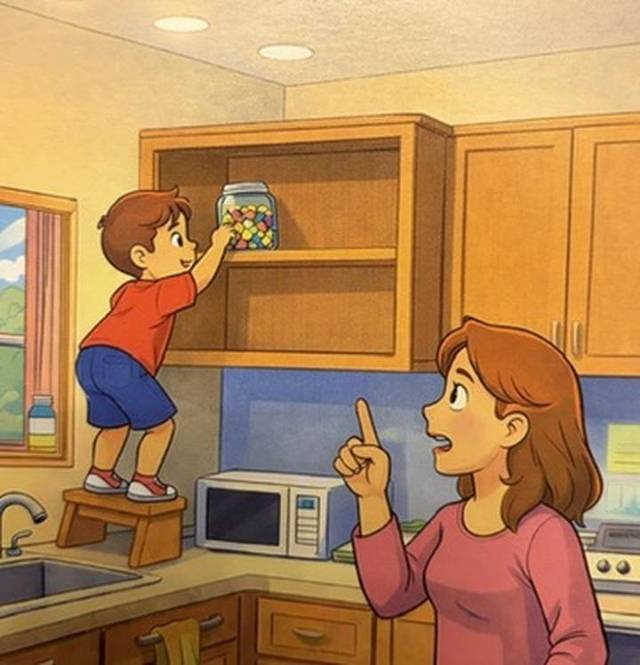
“I was only looking.”
How to use this card
Being told off and being kept safe can arrive in the same sentence.
What’s happening
He is standing on a kitchen stool with his arm into a high cupboard, fingers nearly on the sweet jar. She has come in behind him and her hand is already up.
Each side of it
Him He is after one sweet and he has very nearly got it. The stool is just the way of getting there.
Her She can see the stool, the height, the glass jar and exactly what the next two seconds could look like.
What to ask
- What is he standing on? What’s above him?
- What might happen next if nobody says anything?
- Is she cross, or frightened? How would you tell the difference in a real kitchen?
- He’s about to hear “no”. Is the “no” about the sweets or about the stool?
- What could he have asked instead of climbing?
Things you could say
- “Can I have one after tea?”
- “Ask me and I’ll get it down — that stool tips.”
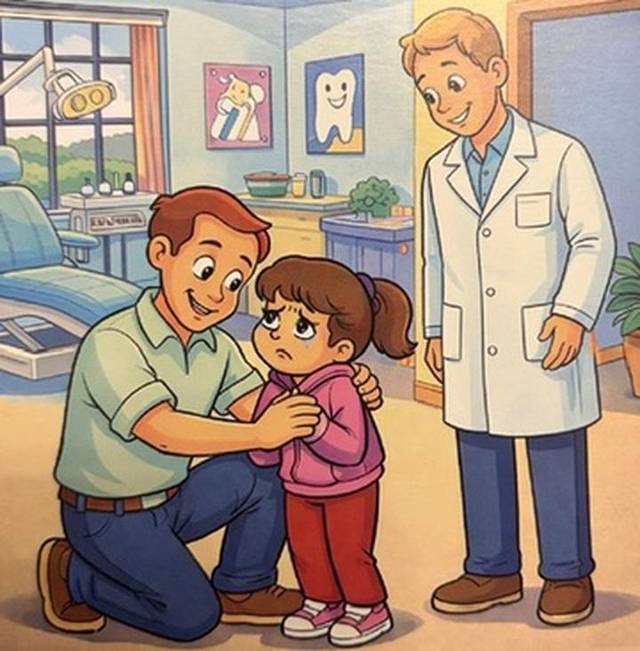
“I don’t want to.”
How to use this card
A kind smile from a stranger isn’t safety yet.
What’s happening
A dentist’s surgery. She has pressed herself into her father’s shoulder. He has knelt down to her height. The dentist is standing back a little, smiling.
Each side of it
Her She doesn’t know this man, this room, or what is going to happen in it. Being told he is kind is not the same as feeling safe.
The dentist He is smiling because that is what he does with nervous children. He isn’t laughing at her and he isn’t in a hurry.
What to ask
- How is she feeling? Where is she looking?
- Why is the dentist smiling — is he being unkind by smiling when she’s upset?
- What is dad doing with his arms, and why might that help more than words?
- She knows he’s a dentist. Why doesn’t knowing that make the feeling go?
- What would help her walk to the chair? What helps you somewhere new?
Things you could say
- “You can hold my hand the whole time.”
- “You can put your hand up and he’ll stop.”
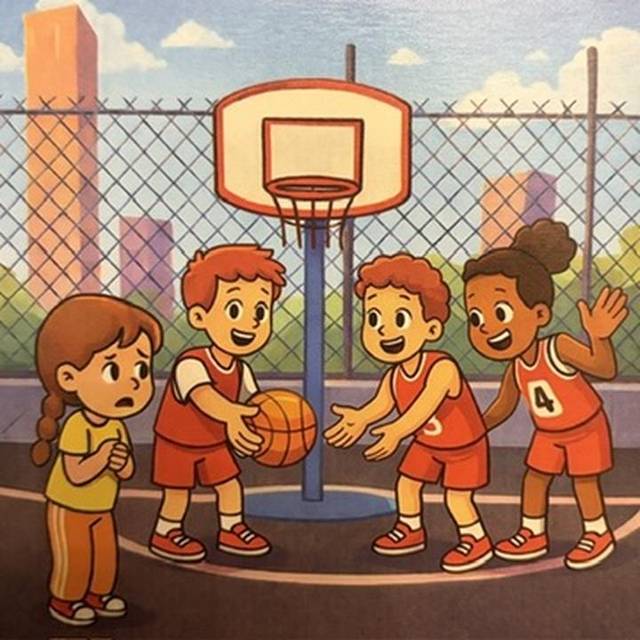
“How do I get in?”
How to use this card
Wanting to join is the easy part. The first sentence is the hard part.
What’s happening
Four children are mid-game on the court. She is standing off to one side with her arms folded, watching.
Each side of it
Her She wants to play and hasn’t found the sentence yet. Every minute she stands there, the sentence gets harder to say.
Them The ball is moving and they are thinking about the ball. It is entirely possible they haven’t seen her.
What to ask
- What might she be thinking as she stands there?
- Have they noticed her and carried on, or not noticed her at all? Can you tell from here?
- When’s a good moment to ask — while the ball’s moving, or between games?
- What exactly could she say? Say it out loud.
- What if they say no? What are two things she could do next?
Things you could say
- “Can I play?”
- “Can I be on a team for the next one?”
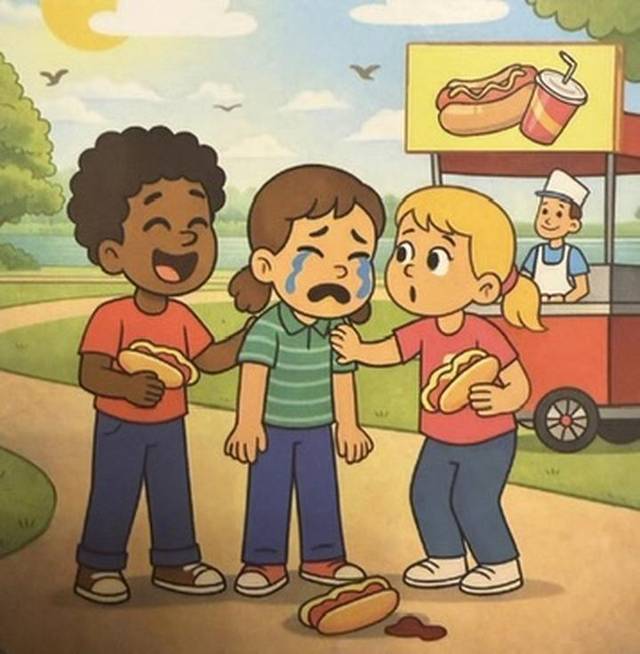
“It’s just funny.”
How to use this card
The same second can be a joke and a disaster.
What’s happening
The hot dog is on the path. She is crying. One boy is laughing openly; the girl beside her has put a hand on her shoulder.
Each side of it
Him Somebody dropped their food and it looked funny. The laugh was out before any thinking happened.
Her That was her lunch, everybody saw it go, and now she is being laughed at on top of it.
What to ask
- Three faces, three feelings. Name each one.
- Did the boy laugh on purpose to be unkind, or did it come out before he thought?
- Does that difference change how it feels to her?
- What can he do now that’s better than saying “it was just funny”?
- The girl on the right didn’t say anything. What did she do that helped?
Things you could say
- “Sorry — I laughed before I thought. Have half of mine.”
- “That’s rubbish. Do you want to go and ask for another one?”
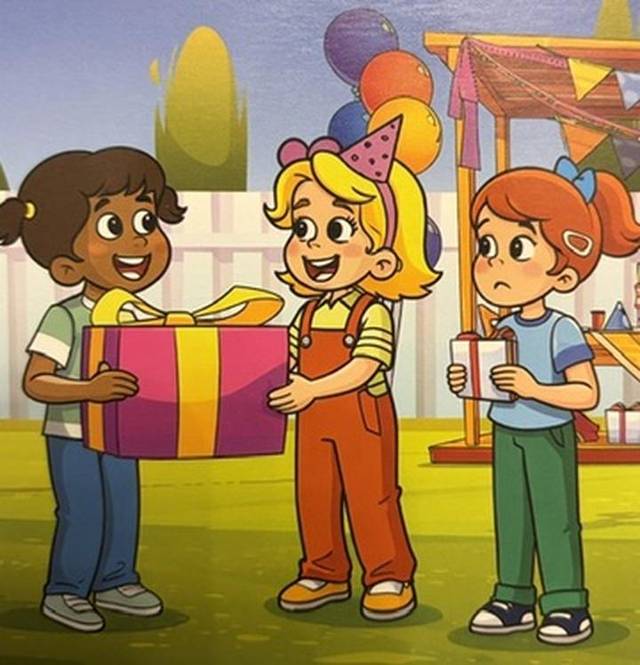
“Mine’s just a card.”
How to use this card
The size of the parcel is not the size of the thought.
What’s happening
A garden party. A large wrapped present is going across to the birthday girl, who is thrilled. Off to the right, another girl stands holding a small card.
Each side of it
The girl with the card She is comparing what is in her hands with what is in somebody else’s, and she has decided she is losing.
The birthday girl She hasn’t counted anything. She is looking at her friends, and in a week she won’t remember what was in the box.
What to ask
- How is the girl on the right feeling? What gave it away?
- Does the birthday girl look like she’s comparing the presents?
- Whose idea is it that a card is worth less — hers, or somebody else’s?
- What could the birthday girl say when she opens it?
- What could the girl with the card say to herself before she hands it over?
Things you could say
- “You came — that’s the bit I wanted.”
- “I made this one myself.”
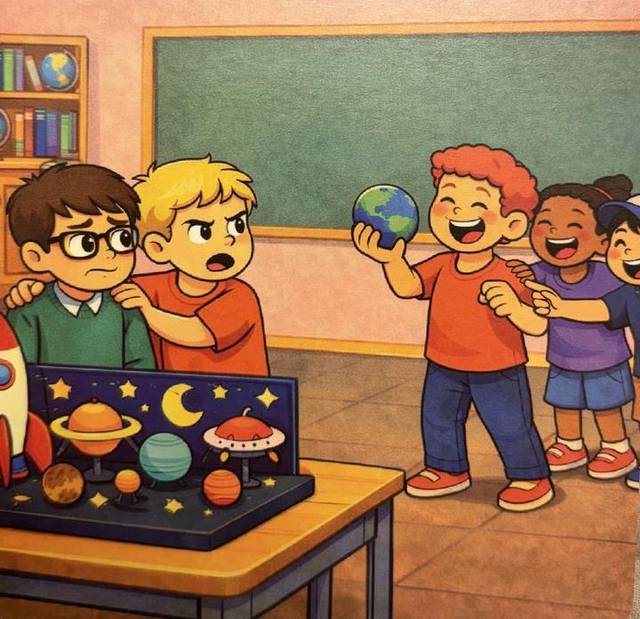
“Everyone’s crowding round his.”
How to use this card
Jealousy is admiration that hasn’t found anywhere to sit.
What’s happening
Two projects in a classroom. The whole group has gathered round the boy holding up the globe. Next to the solar-system model, one boy scowls and points while his friend stares at the floor.
Each side of it
The two by the model They built that, and nobody came over. It feels like a verdict on them rather than a crowd that drifted.
The boy with the globe He is being cheered and is enjoying it. He has not noticed that anyone has been left out of it.
What to ask
- What have both groups made? Look at the table as well as the globe.
- How do the two boys on the left feel? Which one is angry and which one is hurt?
- Does their model get worse because people liked his?
- What did they want that they didn’t get — a prize, or being looked at?
- What could they say to him? What could he say to them?
Things you could say
- “Yours is really good. Will you come and look at ours?”
- “I wanted people to look at mine too. That’s all.”
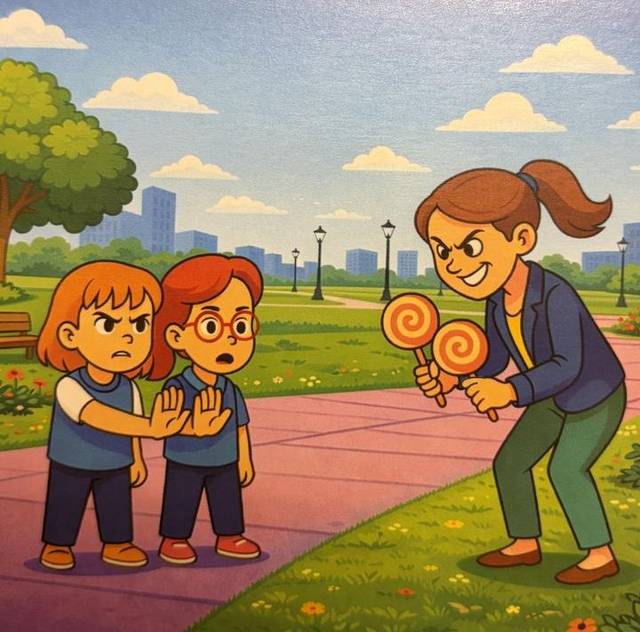
“A lady offered us sweets.”
How to use this card
Grown-ups who need help ask other grown-ups.
What’s happening
A park path. An adult has crouched down and is holding out two lollipops towards two children. The child in front has both hands up and has stepped across her friend.
Each side of it
The adult Whatever she is saying, this is a grown-up approaching children she doesn’t know and offering them something.
The girl in front She worked out in about a second that this was wrong, and has put her body between it and her friend.
What to ask
- What is the woman holding out? Why might she have chosen sweets?
- What has the girl in front decided to do with her hands and her feet?
- Is it rude to walk away from a grown-up? (No. This is the one time it isn’t.)
- Who could they walk to right now? Name three real people or places near you.
- What do you say? Practise it — two words, then move.
Things you could say
- “No thank you.” Then walk, don’t explain.
- “I’m going to find my grown-up.”
- To the adult afterwards: “Somebody I don’t know tried to give us sweets.”
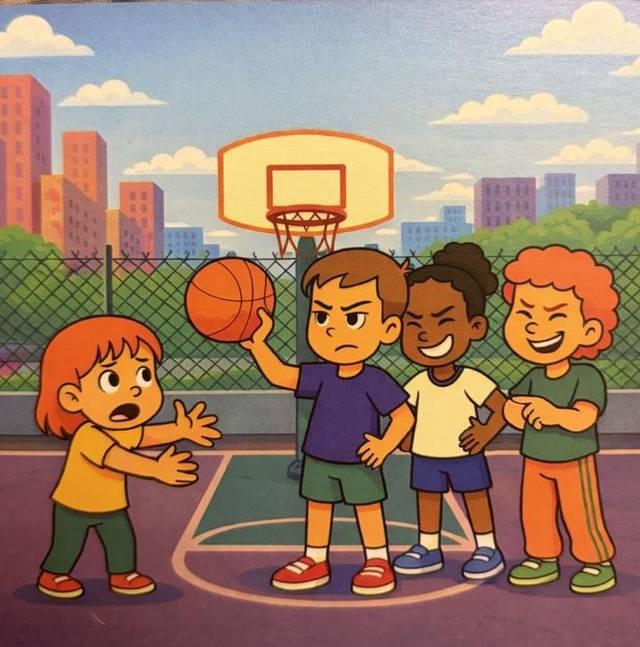
“They’re holding it away.”
How to use this card
Messing about and leaving somebody out look the same for the first few seconds.
What’s happening
She has asked for the ball with both hands out. He is holding it away from her, and the two children behind him are enjoying watching.
Each side of it
Her She has asked, and the asking itself has become the entertainment. Asking again makes it worse.
Them They would call this messing about. The two faces at the back say it stopped being that a while ago.
What to ask
- What is she asking for? What are her hands doing?
- Look at the three faces opposite. Are they all enjoying the same thing?
- Is this still a game? How would you know when it stopped being one?
- What could she say, and how many times should she say it before she stops asking?
- One of those three could end this. What would they have to say?
Things you could say
- “Can I have a turn?” — said once, then walk away.
- “Give it back. That’s not funny now.”
- “I don’t like this game. I’m going to find someone else to play with.”
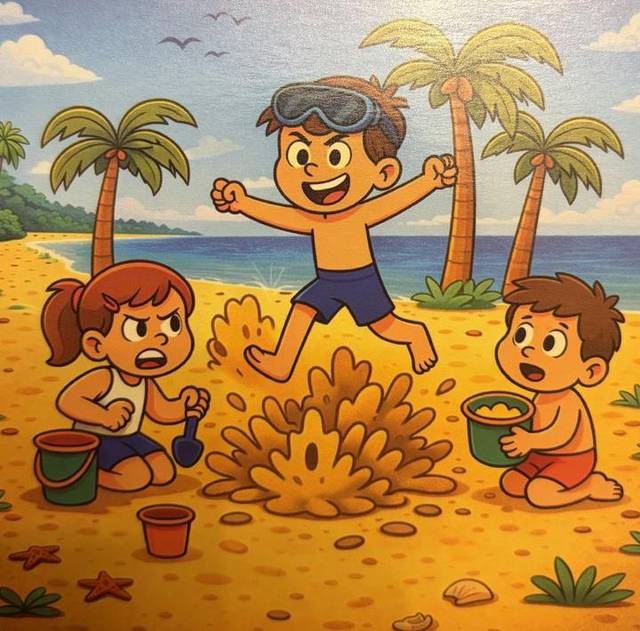
“I was only messing about.”
How to use this card
A second of fun for one person can be an hour of somebody else’s work.
What’s happening
A beach. The castle took a while — there is a spade, two buckets and a smaller brother helping. He has landed in the middle of it with his arms out, delighted.
Each side of it
Him It was a big pile of sand and jumping into it was brilliant. The whole thing lasted a second.
Her It was most of the morning, she was the one making it, and out of everything on this beach he picked hers.
What to ask
- How long might that castle have taken? What tools can you see?
- What did he think would happen? What did he not think about at all?
- What is she feeling — is it only anger?
- Is “I was only joking” an apology? What’s missing from it?
- What could he do in the next minute that would actually help?
Things you could say
- “I wrecked it. I’m sorry — I’ll help you build it again.”
- “I’m too cross to talk to you yet. Ask me in a bit.”
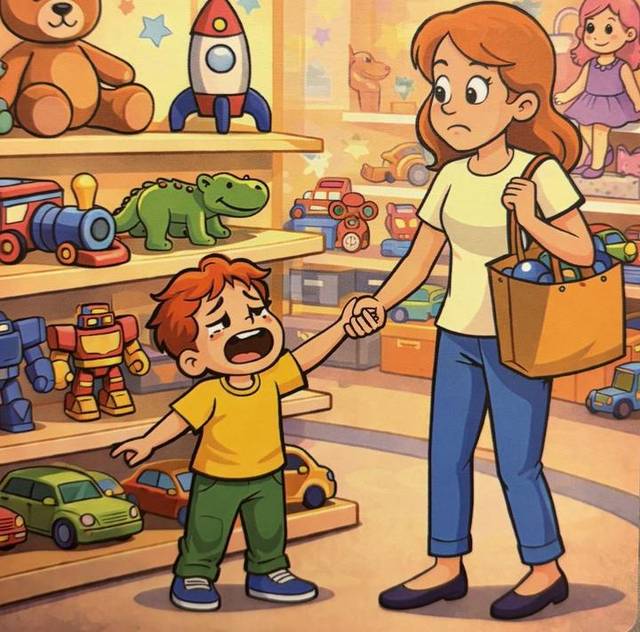
“But I want it.”
How to use this card
Wanting something enormously isn’t the same as needing it now.
What’s happening
A toy shop. He is crying and pulling one way while his hand is held the other way. She is holding on, looking completely worn out.
Each side of it
Him The wanting is enormous, it is happening now, and he has no way at all of making it smaller.
Her She has said no and she meant it. She is also tired, in a shop, and being watched by other people.
What to ask
- What is his body doing — which way is each arm pointing?
- How does the grown-up look? Cross, tired, or sad? Could it be more than one?
- What does the feeling do if he waits ten minutes? Does it stay that big?
- What could he say instead of crying that would be more likely to work?
- Where could that toy go so it isn’t lost — a list, a birthday, a photo?
Things you could say
- “Can I put it on my birthday list?”
- “I’m really disappointed. Can we look at it once before we go?”
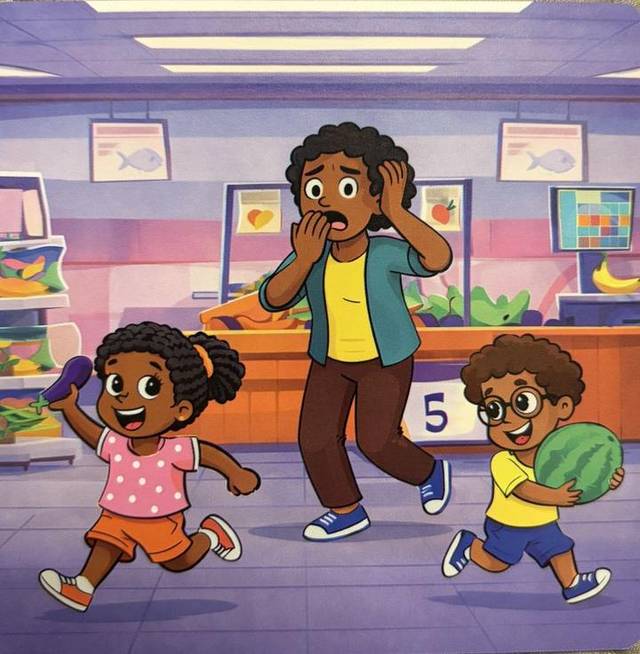
“We were only helping.”
How to use this card
Helpful and safe are two separate tests. This passes one.
What’s happening
Two children are running down a supermarket aisle, one carrying an aubergine and one carrying a watermelon. The adult behind them has both hands up at their face.
Each side of it
Them They are helping, they got there first, and it is the best part of the shopping trip so far.
The adult Hard floor, a heavy melon, other shoppers, and two children now well out of arm’s reach.
What to ask
- What do you think they were trying to do?
- How does the grown-up feel? What are their hands telling you?
- What could go wrong here — to the shopping, to them, to somebody else?
- They wanted to help. What would helping look like instead?
- Where should you stay in a shop, and what’s the rule about running?
Things you could say
- “Can I carry something?”
- “Shall I put it in the trolley for you?”
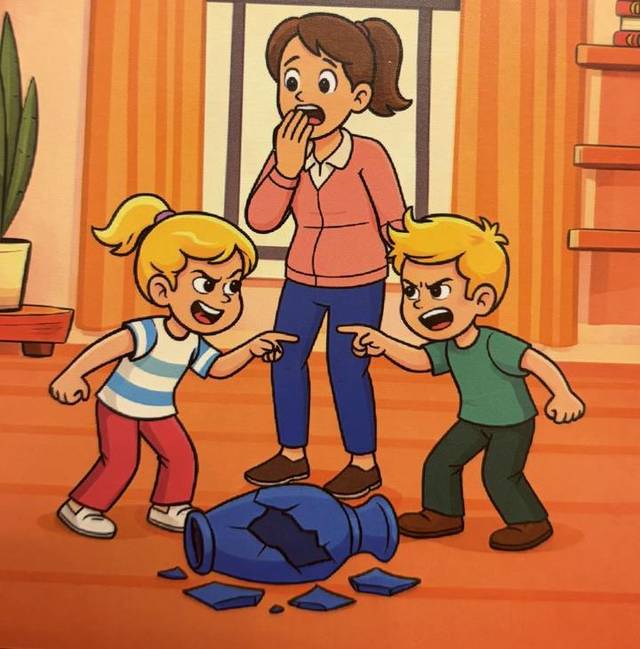
“He did it.”
How to use this card
Two pointing fingers, and nobody mending anything.
What’s happening
The vase is in pieces on the floor. Both children are pointing at each other. The adult behind them has a hand over her mouth.
Each side of it
Both children Each is more frightened of being blamed than sorry about the vase, so each one starts by naming the other.
The adult She doesn’t know who did it, and at this exact moment it is not the thing she is thinking about.
What to ask
- What’s happened, and what are both children doing about it?
- What is each of them most worried about right now?
- Does finding out whose fault it was mend the vase?
- What would change in the room if one of them said “it was me”?
- What’s the first thing that should be said — and the first thing that should be done?
Things you could say
- “It was me. I’m sorry.”
- “It was both of us — we were running inside.”
- “Don’t touch it, there’s sharp bits. I’ll get the brush.”
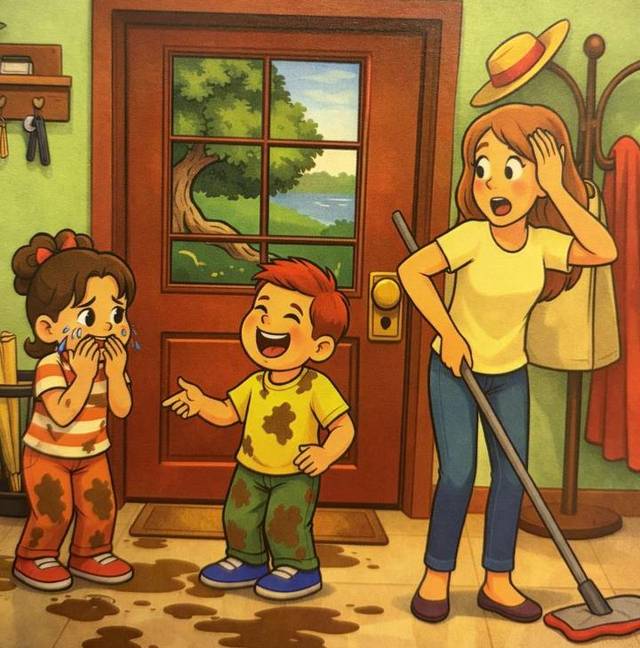
“It’s only mud.”
How to use this card
Same mud. Two completely different afternoons.
What’s happening
Mud across the hall floor and up both of them. He is laughing. She is crying behind her hands. Their mum is standing there with the mop already out.
Each side of it
Him It was a brilliant afternoon and it is still funny now that they are inside.
Her Exactly the same afternoon — and now she thinks she is about to be in serious trouble.
What to ask
- What’s on the floor, and what’s on their clothes?
- Why is one of them laughing and the other one crying about exactly the same thing?
- Who has more work to do now than they did five minutes ago?
- Is the girl in trouble? What might she think is about to happen?
- What could each of them do next — him, her, and the grown-up?
Things you could say
- “Sorry — shoes off. I’ll get the other mop.”
- “You’re not in trouble. It all washes off.”
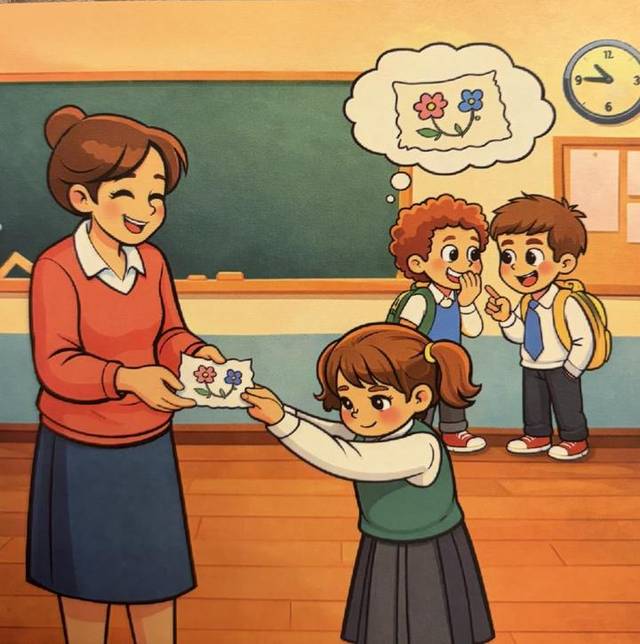
“She made her a picture.”
How to use this card
Doing a kind thing where people can see you takes twice the nerve.
What’s happening
She is handing her teacher a drawing of two flowers. Behind her, two classmates are whispering, and the same drawing is in their thought bubble.
Each side of it
Her She made something for somebody and is handing it over in front of the class. That took more nerve than making it did.
The two at the back They are commenting. Possibly about her, possibly about the idea. Either way they are watching rather than doing.
What to ask
- What has she made, and who is it for?
- What are the two children at the back doing? What’s in their thought bubble?
- Does what they think make the picture any less kind?
- How would she feel if she turned round and heard them?
- What could those two say instead? What would you want someone to say if it were you?
Things you could say
- “I made this for you.”
- “That’s nice — I might make one too.”
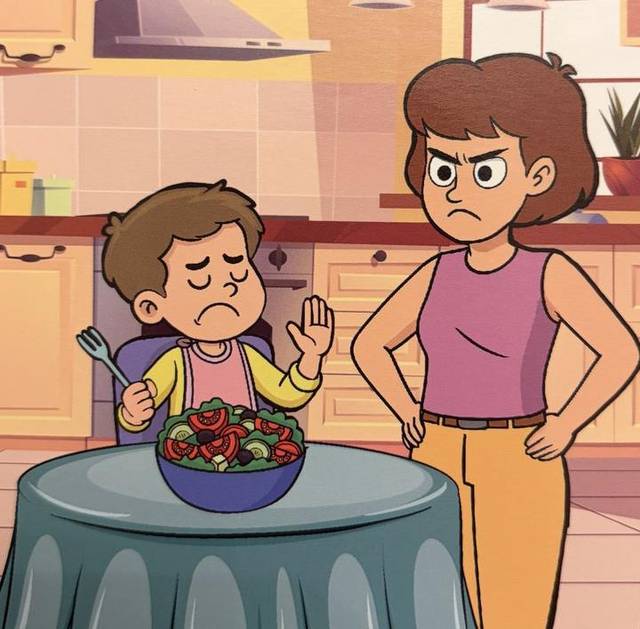
“I’m not eating that.”
How to use this card
A refusal and a reason are two different sentences.
What’s happening
A bowl of salad in front of him, fork in one hand and the other hand up in a stop. She is standing over the table with her hands on her hips.
Each side of it
Him There is something in that bowl he doesn’t want, and “no” is the fastest thing to say.
Her She has been handed a flat refusal with nothing in it she can do anything about.
What to ask
- What’s in the bowl? Is it all one thing, or lots of things?
- What is the child’s raised hand saying without any words?
- How does the grown-up feel? What would you guess she’s about to say?
- What’s the difference between “I’m not eating that” and “I don’t like tomatoes”?
- Which one gives the grown-up something to work with?
Things you could say
- “I don’t like the tomatoes. Can I have the cucumber bits?”
- “Can I try a little and leave the rest?”
Staff sheet
For the adult, not the child. Do not read this out alongside the card — it gives the answer, and the thinking is the point. It prints on its own page.
- Card 1 — “I don’t like you… just kidding.”
“Just kidding” does not cancel what came before it. The hurt has already landed, and the joker’s laughter makes it harder to object. - Card 2 — “He never drank it.”
A polite thank-you is not the same as wanting the thing. Watch what people do afterwards, not only what they say in the moment. - Card 3 — “nice.”
A very short reply to a long message usually means low energy or distraction, not dislike. It is the most commonly over-read signal there is. - Card 4 — “Wow, it’s late.”
This is a hint, not an observation about the time. It means “I would like this to end now” without saying so. - Card 5 — “That’s really good… for a first try.”
A compliment with a qualifier on the end. The first half is praise, the second half takes it back — and the speaker may not realise they did it. - Card 6 — “I didn’t want to go anyway.”
Said after being left out. It is protection, not a preference — disagreeing with it usually makes things worse than accepting it. - Card 7 — “I’m sorry I shouted, but you weren’t listening.”
Anything after “but” replaces the apology. The sentence moves the fault across the room while sounding like an apology. - Card 8 — “I’m sorry. I’m sorry. I’m sorry.”
Repeating an apology is distress, not politeness. It usually means “I am frightened of what happens next.” Asking for one more apology makes it worse. - Card 9 — “It was my game.”
Having your idea taken up is not the same as being included in it. This is a common and genuinely confusing kind of loss. - Card 10 — “They walked straight past.”
Being walked past is not always a decision about you. People in conversation frequently do not see who is nearby. - Card 11 — “He said it’s fine, so it’s fine.”
“I’m fine” is often a way to end a conversation, not a report. Taking it at face value is reasonable — and can still leave someone stuck. - Card 12 — “Read.”
A read receipt with no reply is the single most over-interpreted thing on a phone. It carries almost no information about what the other person thinks. - Card 13 — “They’re laughing.”
Laughter nearby is not evidence that it is about you — but it very reliably feels as though it is. - Card 14 — “The bit in the middle.”
Repair is rarely a conversation. Most of it is the ordinary quiet time in between, and it is easy to miss that it happened at all. - Card 15 — “Everyone else finds this easy.”
The comparison is with other people’s outsides. Everyone in the room is carrying something you cannot see. - Card 16 — “He’s staring at me.”
Gaze is ambiguous. It can mean interest, worry, distraction or nothing at all, and reading it as hostility is a common and costly error. - Card 17 — “I went on too long.”
The worry arrives after the conversation, not during it. Being enthusiastic at length is not the social failure it feels like afterwards. - Card 18 — “One sec.”
“One sec” is almost never one second. It means “not now”, and the gap between the words and the meaning is the whole difficulty. - Card 19 — “The bowling alley’s shut.”
A plan collapsing is not a social rejection, though it can feel identical — especially when you were the one looking forward to it most. - Card 20 — “It was a good night.”
Enjoying something and being exhausted by it are not contradictory. The tiredness afterwards does not mean you did not want to be there. - Card 21 — “The card with the cross on it.”
When a child is overloaded, adding a choice — even a visual one — is another demand. The cards work before the overload, not during it. - Card 22 — “Everyone’s doing it.”
“Everyone” is rarely everyone, and the pressure of it is real whether or not the claim is true. - Card 23 — “I know what I need to do.”
Knowing the task and being able to start it are different problems. Being told the task again does not help; starting somewhere very small does. - Card 24 — “Sorry — I’ll forget it.”
Interrupting to hold on to a thought is usually memory pressure, not rudeness. Saying so out loud helps more than apologising for it. - Card 25 — “I want to help but I don’t know how.”
Not knowing what to offer stops most people helping at all. Sitting nearby and saying nothing is a real option and often the right one. - Card 26 — “No thank you.”
A refused hug is not a rejection of the person. “No thank you” is a complete answer and does not need a reason. - Card 27 — “He didn’t ask for it.”
Noticing is a separate skill from helping, and a quieter one. Most people who need something never get round to asking for it. - Card 28 — “I’ll just get it down.”
Fear usually comes out sounding like anger. If somebody shouts at you while you are doing something risky, work out which one it is before you argue back. - Card 29 — “It’s too big for one.”
Some jobs make friends out of people who were only standing near each other. Needing someone is not the same as owing them. - Card 30 — “It was his fault.”
Blame moves a feeling from one child to another. It never gets rid of it, and it has never once changed a score. - Card 31 — “She found my hat.”
Two people can be delighted in the same second for completely different reasons. It is worth thanking the person as well as grabbing the thing. - Card 32 — “Do you want half?”
A real offer leaves the other person free to say no. If refusing would cause trouble, it was never an offer in the first place. - Card 33 — “You’ll be fine.”
Reassurance argues with the feeling. Company sits down next to it. The second one tends to work better. - Card 34 — “I was only looking.”
Two completely different “no”s can sound the same. One is about sweets before tea. The other is about a glass jar landing on a tiled floor. - Card 35 — “I don’t want to.”
Trust is built out of time and experience, not information. Nobody has ever been talked into feeling safe. - Card 36 — “How do I get in?”
Being left out and not being noticed look exactly the same from the edge of a court. The only way to find out which one it is, is to ask. - Card 37 — “It’s just funny.”
A laugh that wasn’t meant unkindly still lands unkindly. What he does in the ten seconds afterwards is the part that counts. - Card 38 — “Mine’s just a card.”
Comparing is something you do to yourself. Nobody else in this picture is doing it to her. - Card 39 — “Everyone’s crowding round his.”
Jealousy is usually admiration with nowhere to put itself. The model did not get any worse when the crowd moved across the room. - Card 40 — “A lady offered us sweets.”
Adults who genuinely need help ask other adults. A grown-up asking a child for anything — help, company, a secret, a minute of their time — is the signal, whatever they happen to be holding. - Card 41 — “They’re holding it away.”
Teasing and playing look identical for the first few seconds. The test is simple: is the person on the other end of it laughing? - Card 42 — “I was only messing about.”
“I was only messing about” explains what he meant. It doesn’t go anywhere near what actually happened. - Card 43 — “But I want it.”
A want that big genuinely feels like a need. It does shrink on its own, which is impossible to believe while you are inside it. - Card 44 — “We were only helping.”
Meaning well and being safe are two separate tests. This passes the first one comfortably and fails the second. - Card 45 — “He did it.”
Two pointing fingers, and nobody sweeping anything up. Whoever says “it was me” first usually ends the entire thing. - Card 46 — “It’s only mud.”
One event, two completely different feelings, and neither child is wrong. The one who is laughing is usually the one who has to notice. - Card 47 — “She made her a picture.”
Doing a kind thing where people can see costs more than doing it privately. The whispering behind her doesn’t make the picture any less kind. - Card 48 — “I’m not eating that.”
“I’m not eating that” closes the conversation. “I don’t like the tomatoes” opens one. Same no, very different amount of information.
Written for staff and parents supporting autistic and other neurodivergent children. It describes common patterns, not any individual child, and is not a diagnostic tool.