Thermoregulation in a bearded dragon
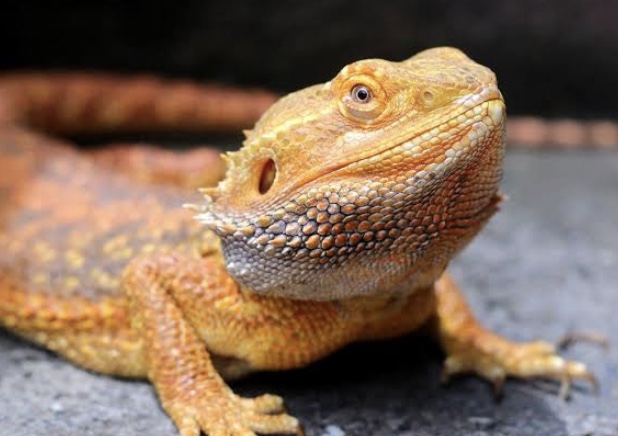
this is a bearded dragon at Pets on the Green. He cannot generate his own body heat — so every day he has to behave his way to the right temperature. Watch him do it, and negative feedback stops being an arrow on a diagram.
The problem an ectotherm has
An endotherm (you) makes heat internally from respiration and holds a near-constant core temperature — roughly 37 °C — whatever the room does. It costs a great deal of energy: most of what you eat is spent staying warm.
An ectotherm (our bearded dragon) does not. His body temperature tracks his surroundings. So he cannot solve the problem physiologically — he solves it behaviourally, by moving between places of different temperature. That is why his vivarium has a hot end and a cool end. Give a bearded dragon one uniform temperature and you have taken away the only mechanism he has.
Watch our bearded dragon regulate
Click a zone to move him, or press Run a day and watch what he chooses. His target core temperature is about 35 °C. Notice he never sits still at it — he overshoots, corrects, overshoots the other way. That oscillation is negative feedback.
The husbandry point, which is also the exam point: a keeper who sets the whole vivarium to 35 °C thinks they are being kind. They have actually removed the gradient — and with it, the animal's ability to regulate at all. The gradient is the welfare requirement, not the average.
Endotherm vs ectotherm
| Endotherm (you) | Ectotherm (our bearded dragon) | |
|---|---|---|
| Heat source | Internal — respiration | External — the environment |
| Main response | Physiological: vasodilation, sweating, shivering | Behavioural: move, bask, shade, flatten |
| Energy cost | Very high — most of your food | Low — can go weeks between meals |
| In the cold | Burn more fuel, stay active | Slow down; digestion stops |
| Receptors | Thermoreceptors → hypothalamus | Thermoreceptors → behaviour |
Both are negative feedback: a deviation from the set point triggers a response that reverses the deviation. The set point is the same idea. Only the effector differs.